ABSTRACT
Exercise, especially when prolonged or highly intense, can temporarily increase inflammation in both trained and untrained individuals. C-reactive protein (CRP) is an established biomarker of inflammation. However, clinical trials assessing the impact of fish oil supplementation on CRP levels in trained individuals have yielded inconsistent and often contradictory results. The main objective of this study was to conduct a systematic review of clinical trials exploring the effects of fish oil supplementation on CRP levels among trained individuals. We performed structured searches on the PubMed, Scopus, and ISI Web of Science databases for articles published from the earliest available date until September 2023. Of the 385 articles found and screened, three clinical trials met our criteria for inclusion in this review. The results suggested that fish oil supplementation may help prevent spikes in CRP levels after exercise. However, only one of the three studies produced statistically significant findings. The differences in statistical significance among these studies could be due to variations in the study design, sample populations, dosages, and duration of supplementation. In summary, this systematic review provides evidence that fish oil supplementation can reduce circulating CRP levels in trained individuals. Additional studies with long-term follow-up and larger sample sizes are needed to investigate this effect further.
-
Keywords: Fish oil; Omega-3 fatty acids; C-reactive protein; Inflammation; Systematic review
INTRODUCTION
Exercise, especially when prolonged or high-intensity, can lead to a temporary increase in inflammation in both trained and untrained individuals [
1,
2,
3,
4]. Intense exercise causes microscopic damage to muscle fibers, triggering the release of proinflammatory cytokines, such as interleukin-6 (IL-6), and activating the immune system [
5,
6,
7,
8]. This process results in elevated levels of C-reactive protein (CRP), a key marker of systemic inflammation [
9,
10]. If CRP levels remain elevated and inflammation becomes chronic, it can exacerbate or contribute to the development of various disorders, including type 2 diabetes, cardiovascular diseases, and impaired immune function [
11,
12,
13,
14]. To mitigate inflammation, it is crucial to regulate exercise intensity and duration properly [
15,
16]. Nutrition also plays a vital role in inflammation regulation. Consuming foods rich in antioxidants, such as fruits and vegetables, omega-3 fatty acids (found in fatty fish and nuts), and adequate protein can help protect against and reduce inflammation [
17,
18,
19].
Omega-3 fatty acids have shown significant anti-inflammatory effects, especially evidenced by reduced CRP levels, in previous studies [
20,
21]. These effects are exerted through the modulation of proinflammatory cytokines, which play a role in the synthesis of CRP [
22,
23]. Clinical studies have indicated that regular consumption of omega-3 fatty acids, particularly in the form of fish oil supplements, can significantly reduce CRP levels [
23,
24,
25,
26]. This is especially beneficial for individuals with chronic inflammation or those recovering from physical exertion [
27]. Fish oil supplements provide a concentrated and bioavailable source of eicosapentaenoic acid (EPA) and docosahexaenoic acid (DHA). This makes them an effective means of achieving the recommended omega-3 intake, particularly for those who do not consume much fatty fish [
25,
28]. However, the results of clinical trials on the effects of fish oil supplementation on CRP levels in trained individuals have been inconsistent and often contradictory. While some studies have demonstrated significant reductions in CRP with fish oil supplementation, others have found minimal or no effect [
29,
30,
31,
32]. Given the conflicting evidence, there is a need for a comprehensive systematic review to synthesize the existing data and clarify the potential role of fish oil in modulating CRP levels. Therefore, the primary objective of this study was to conduct a systematic review of clinical trials examining the effects of fish oil supplementation on CRP levels in trained individuals.
METHODS
This systematic review was conducted and reported according to the guidelines of the Preferred Reporting Items for Systematic Reviews and Meta-Analyses [
33].
We performed a structured search of the PubMed, Scopus, and ISI Web of Science databases for articles published from the earliest available date up to September 2023. The search was restricted to English language articles and used the following keywords, interposed with Boolean operators: (“fish oil” OR “omega-3 fatty acid” OR “n-3 fatty acid” OR “DHA” OR “eicosapentaenoic acid” OR “docosahexaenoic acid” OR “EPA”) AND (“inflammation” OR “C-reactive protein” OR “CRP”) AND (“athletes” OR “training” OR “exercise”). The reference lists of the retrieved articles were also screened manually to enhance the sensitivity of the search strategy and ensure that all relevant clinical trials were identified.
Study selection
The articles retrieved from the electronic databases were organized using EndNote X6 software (EndNote X6; Thomson Reuters, New York, NY, USA). Duplicate studies were removed from the initial search results. Two independent researchers (JK and PS) then screened the titles and abstracts based on the eligibility criteria. The same authors later screened the full-text articles. Articles were included if they met the following criteria: (a) Participants were trained healthy individuals; (b) The trial investigated the effects of supplementation with omega-3 from a fish oil source for at least 1 week; (c) There was a comparison group; (d) CRP was the primary outcome measured; and (e) The study was a clinical trial. Studies with children and adolescents were excluded. Studies that examined the effects of fish oil in combination with other ingredients were also excluded unless that compound was also used with the control group. Any disagreements between the two reviewers were resolved through discussion until a consensus was reached.
Data extraction
A standard data extraction form was used by two independent reviewers (JK and PS) to collect and collate information on the key characteristics of the articles. This included the first author’s last name, publication year, study location (country), sex and mean age of the participants, total sample size, follow-up duration, and dosage of fish oil supplements. Any discrepancies between the data collected by the two reviewers were resolved through discussion or arbitration by a third reviewer (LK). If any of this information was not reported in the article, we contacted the corresponding author to obtain the necessary data.
RESULTS
Search results and study characteristics
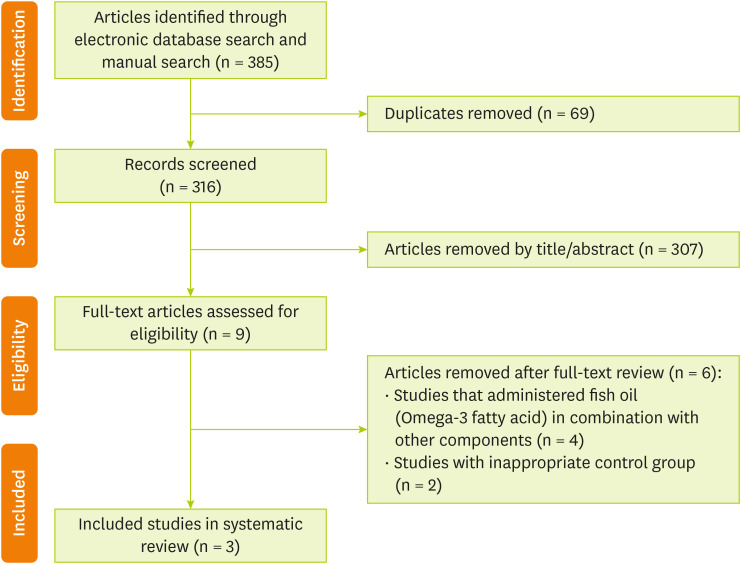
Figure 1 provides a flowchart illustrating the study selection process for this review. In total, 385 potentially eligible articles were identified through electronic database search and manual search of reference lists from relevant studies. After removing duplicate records, 316 articles remained. Of these, 307 were excluded during the screening of titles and abstracts as they did not meet the inclusion criteria. We retrieved the nine remaining articles and screened the full text of each article. After analyzing the full texts, six articles were removed because they did not meet the inclusion criteria. Finally, only three studies satisfied our inclusion criteria for qualitative synthesis. Most of the studies included in this systematic review used a parallel design. The studies took place in Belgium, Brazil, and Iran. The average duration of supplementation was 45 days. The number of participants ranged from 8 to 23, and their mean age was 40 years. A summary of the characteristics of the three studies is presented in
Table 1.
Figure 1Flow chart of the study selection process.

Table 1Characteristics of the included studies
Table 1
|
Studies |
Country |
Sample size |
Sex |
Mean age (yr) |
Supplement course (wk) |
Participants |
Intervention (dosage) |
Exercise type |
|
Dalle et al. [29] (2021) |
Belgium |
23 |
Both |
65–83 |
14 |
Healthy older adults |
Omega-3 fish oil (3.3 g/day) |
Resistance exercise |
|
Marques et al. [30] (2015) |
Brazil |
8 |
Male |
33.8 |
4 |
Wheelchair basketball athletes |
Fish oil (3 g/day) |
Aerobic training |
|
Atashak et al. [32] (2013) |
Iran |
20 |
Male |
21 |
1 |
Handball players |
Omega-3 fish oil (3 g/day) |
Resistance exercise |
Effects of fish oil supplementation on serum CRP levels in trained individuals
The impact of omega-3 from fish oil on serum CRP levels was examined in three clinical trials [
29,
30,
32]. The first study was by Dalle et al. [
29] and included both males and females. The study found that daily intake of 3.3 g of omega-3 over 14 weeks, combined with 12 weeks of resistance exercise, did not significantly affect serum CRP levels in healthy older adults. The second study was by Marques et al. [
30]. This study found that daily supplementation with 3 g of DHA-rich fish oil did not alter serum CRP levels after acute exercise in male wheelchair basketball athletes. The third study included in our review was by Atashak et al. [
32]. This study divided 20 collegiate male handball players into two equal groups. Each participant took three capsules a day (3,000 mg) of either omega-3 or a placebo for 7 days. All participants engaged in acute high-intensity resistance exercise. Interestingly, the levels of CRP significantly increased 24 hours after exercise in the placebo group, but not in the omega-3 group. This indicated that omega-3 supplementation can help prevent increases in systemic inflammation caused by acute resistance exercise.
DISCUSSION
Intense and prolonged physical activity can lead to systemic inflammation, which is indicated by elevated levels of CRP, a well-known biomarker for inflammation. Although this physiological response is important for tissue repair and adaptation, if it persists for too long, it can impair recovery, decrease athletic performance, and increase the risk of overtraining syndromes and various diseases. Omega-3 fatty acids, particularly those found in fish oil, have potent anti-inflammatory properties. They help reduce inflammation by reducing the production of proinflammatory cytokines and eicosanoids and regulating inflammatory pathways.
This systematic review aimed to investigate the effect of fish oil supplementation on serum CRP levels in trained individuals. We found that fish oil supplementation can help prevent spikes in CRP levels after exercise; however, the findings were statistically significant in only one of the studies. This may be attributed to variations in the study design, sample population, dosage, and duration of supplementation.
Several mechanisms of action have been proposed to explain the beneficial effects of fish oil on serum CRP levels in trained individuals. These effects are primarily due to the anti-inflammatory properties of omega-3 fatty acids in fish oil, specifically EPA and DHA [
25]. These omega-3 fatty acids lower CRP levels by influencing key inflammatory pathways. They also inhibit the production of proinflammatory cytokines, such as IL-6 and tumor necrosis factor-alpha [
26], both of which are strong stimulators of hepatic CRP production [
34]. In addition, EPA and DHA reduce the formation of proinflammatory eicosanoids, such as prostaglandins and leukotrienes, by competing with arachidonic acid for enzymatic conversion through the cyclooxygenase and lipoxygenase pathways [
35,
36]. Omega-3 fatty acids also decrease the activation of the transcription factor nuclear factor-kappa B, which regulates the expression of various inflammatory mediators, including CRP [
37,
38]. Through these mechanisms, fish oil supplementation can effectively lower systemic inflammation and CRP levels, leading to improved recovery from exercise and potentially reducing the risk of chronic inflammatory conditions [
28,
39].
A meta-analysis by Kavyani et al. [
26] found that n-3 polyunsaturated fatty acid supplementation significantly reduced the levels of serum inflammatory biomarkers, particularly CRP. Notably, the beneficial effects of DHA and EPA alone were specific to CRP levels.
Fish oil is considered beneficial to health, largely due to its anti-inflammatory properties. However, excessive consumption of fish oil can cause several unwanted side effects, such as an increased risk of bleeding as omega-3 fatty acids inhibit platelet aggregation. This is of particular concern in individuals who are on blood-thinning medications or have bleeding disorders [
40]. Gastrointestinal discomfort is another common issue, which can manifest as bloating, indigestion, or diarrhea when fish oil is taken in large doses [
40,
41]. In addition, evidence suggests that overconsumption of omega-3 fatty acids may suppress certain aspects of immune function, potentially increasing susceptibility to infections [
42,
43]. In rare instances, those with fish or shellfish allergies may also have allergic reactions to fish oil [
43]. As with any supplement, it is important to exercise caution and adhere to dosage guidelines. Ideally, supplements should be implemented under the guidance of a healthcare provider to avoid potential risks and maximize benefits.
The current systematic review had several limitations that should be considered when interpreting the results. These include the small number of articles and the short intervention durations. Furthermore, in some of the included studies, dietary intake was not measured before and after the intervention, which may have caused biases resulting from confounding factors. Another limitation was our failure to assess the quality of the included studies. Finally, the protocol for the present study was not recorded in the PROSPERO registry. This omission may potentially have introduced bias.
CONCLUSION
This systematic review found that fish oil supplementation can lower circulating CRP levels in trained individuals. Additional studies with long-term follow-up and larger sample sizes are needed.
NOTES
-
Conflict of Interest: The authors declare that they have no competing interests.
-
Availability of Data and Materials: The dataset and analyses from this study are available from the corresponding author upon reasonable request.
-
Author Contributions:
Conceptualization: Karimian J, Shekarchizadeh-Esfahani P.
Data curation: Karimian J, Shekarchizadeh-Esfahani P.
Formal analysis: Karimian J.
Funding acquisition: Karimian J.
Investigation: Karimian J, Shekarchizadeh-Esfahani P.
Methodology: Karimian J, Khaghani L, Shekarchizadeh-Esfahani P.
Project administration: Karimian J, Shekarchizadeh-Esfahani P.
Resources: Karimian J, Shekarchizadeh-Esfahani P.
Software: Karimian J.
Supervision: Shekarchizadeh-Esfahani P.
Validation: Karimian J, Shekarchizadeh-Esfahani P.
Visualization: Karimian J, Shekarchizadeh-Esfahani P.
Writing - original draft: Karimian J, Khaghani L, Shekarchizadeh-Esfahani P.
Writing - review & editing: Karimian J, Shekarchizadeh-Esfahani P.
REFERENCES
- 1. Ashtary-Larky D, Lamuchi-Deli N, Milajerdi A, Salehi MB, Alipour M, et al. Inflammatory and biochemical biomarkers in response to high intensity resistance training in trained and untrained men. Asian J Sports Med 2017;8:e13739.
- 2. Metsios GS, Moe RH, Kitas GD. Exercise and inflammation. Best Pract Res Clin Rheumatol 2020;34:101504.
- 3. Salehi M, Mashhadi NS, Esfahani PS, Feizi A, Hadi A, et al. The effects of curcumin supplementation on muscle damage, oxidative stress, and inflammatory markers in healthy females with moderate physical activity: a randomized, double-blind, placebo-controlled clinical trial. Int J Prev Med 2021;12:94.
- 4. Hadi A, Pourmasoumi M, Kafeshani M, Karimian J, Maracy MR, et al. The effect of green tea and sour tea (Hibiscus sabdariffa L.) supplementation on oxidative stress and muscle damage in athletes. J Diet Suppl 2017;14:346-357.
- 5. Pyne DB. Exercise-induced muscle damage and inflammation: a review. Aust J Sci Med Sport 1994;26:49-58.
- 6. Moldoveanu AI, Shephard RJ, Shek PN. The cytokine response to physical activity and training. Sports Med 2001;31:115-144.
- 7. Mirenayat MS, Faramarzi M, Ghazvini MR, Karimian J, Hadi A, et al. The effects of short term citrulline malate supplementation on oxidative stress and muscle damage in trained soccer players. Hum Nutr Metab 2024;36:200242.
- 8. Tavakoly R, Hadi A, Rafie N, Talaei B, Marx W, et al. Effect of probiotic consumption on immune response in athletes: a meta-analysis. Int J Sports Med 2021;42:769-781.
- 9. Pedersen BK. Special feature for the Olympics: effects of exercise on the immune system: exercise and cytokines. Immunol Cell Biol 2000;78:532-535.
- 10. Zembron-Lacny A, Tylutka A, Zeromska A, Kasperska A, Wolny-Rokicka E. Does high volume of exercise training increase aseptic vascular inflammation in male athletes? Am J Men Health 2019;13:1557988319858838.
- 11. Ansar W, Ghosh S. C-reactive protein and the biology of disease. Immunol Res 2013;56:131-142.
- 12. Backes JM, Howard PA, Moriarty PM. Role of C-reactive protein in cardiovascular disease. Ann Pharmacother 2004;38:110-118.
- 13. Hunter P. The inflammation theory of disease. The growing realization that chronic inflammation is crucial in many diseases opens new avenues for treatment. EMBO Rep 2012;13:968-970.
- 14. Manabe I. Chronic inflammation links cardiovascular, metabolic and renal diseases. Circ J 2011;75:2739-2748.
- 15. Gleeson M, Bishop NC, Stensel DJ, Lindley MR, Mastana SS, et al. The anti-inflammatory effects of exercise: mechanisms and implications for the prevention and treatment of disease. Nat Rev Immunol 2011;11:607-615.
- 16. Ford ES. Does exercise reduce inflammation? Physical activity and C-reactive protein among U.S. adults. Epidemiology 2002;13:561-568.
- 17. Stumpf F, Keller B, Gressies C, Schuetz P. Inflammation and nutrition: friend or foe? Nutrients 2023;15:1159.
- 18. Di Giosia P, Stamerra CA, Giorgini P, Jamialahamdi T, Butler AE, et al. The role of nutrition in inflammaging. Ageing Res Rev 2022;77:101596.
- 19. Galland L. Diet and inflammation. Nutr Clin Pract 2010;25:634-640.
- 20. Lorente-Cebrián S, Costa AG, Navas-Carretero S, Zabala M, Laiglesia LM, et al. An update on the role of omega-3 fatty acids on inflammatory and degenerative diseases. J Physiol Biochem 2015;71:341-349.
- 21. Calder PC. Omega-3 fatty acids and inflammatory processes: from molecules to man. Biochem Soc Trans 2017;45:1105-1115.
- 22. Yashodhara BM, Umakanth S, Pappachan JM, Bhat SK, Kamath R, et al. Omega-3 fatty acids: a comprehensive review of their role in health and disease. Postgrad Med J 2009;85:84-90.
- 23. Rangel-Huerta OD, Aguilera CM, Mesa MD, Gil A. Omega-3 long-chain polyunsaturated fatty acids supplementation on inflammatory biomakers: a systematic review of randomised clinical trials. Br J Nutr 2012;107(Suppl 2):S159-S170.
- 24. Saifullah A, Watkins BA, Saha C, Li Y, Moe SM, et al. Oral fish oil supplementation raises blood omega-3 levels and lowers C-reactive protein in haemodialysis patients--a pilot study. Nephrol Dial Transplant 2007;22:3561-3567.
- 25. Ellulu MS, Khaza’ai H, Abed Y, Rahmat A, Ismail P, et al. Role of fish oil in human health and possible mechanism to reduce the inflammation. Inflammopharmacology 2015;23:79-89.
- 26. Kavyani Z, Musazadeh V, Fathi S, Hossein Faghfouri A, Dehghan P, et al. Efficacy of the omega-3 fatty acids supplementation on inflammatory biomarkers: an umbrella meta-analysis. Int Immunopharmacol 2022;111:109104.
- 27. Lewis NA, Daniels D, Calder PC, Castell LM, Pedlar CR. Are there benefits from the use of fish oil supplements in athletes? A systematic review. Adv Nutr 2020;11:1300-1314.
- 28. Ghasemi Fard S, Wang F, Sinclair AJ, Elliott G, Turchini GM. How does high DHA fish oil affect health? A systematic review of evidence. Crit Rev Food Sci Nutr 2019;59:1684-1727.
- 29. Dalle S, Van Roie E, Hiroux C, Vanmunster M, Coudyzer W, et al. Omega-3 supplementation improves isometric strength but not muscle anabolic and catabolic signaling in response to resistance exercise in healthy older adults. J Gerontol A Biol Sci Med Sci 2021;76:406-414.
- 30. Marques CG, Santos VC, Levada-Pires AC, Jacintho TM, Gorjão R, et al. Effects of DHA-rich fish oil supplementation on the lipid profile, markers of muscle damage, and neutrophil function in wheelchair basketball athletes before and after acute exercise. Appl Physiol Nutr Metab 2015;40:596-604.
- 31. Phillips T, Childs AC, Dreon DM, Phinney S, Leeuwenburgh C. A dietary supplement attenuates IL-6 and CRP after eccentric exercise in untrained males. Med Sci Sports Exerc 2003;35:2032-2037.
- 32. Atashak S, Sharafi H, Azarbayjani MA, Stannard SR, Goli MA, et al. Effect of omega-3 supplementation on the blood levels of oxidative stress, muscle damage and inflammation markers after acute resistance exercise in young athletes. Kinesiology 2013;45:22-29.
- 33. Moher D, Liberati A, Tetzlaff J, Altman DG. PRISMA Group. Preferred reporting items for systematic reviews and meta-analyses: the PRISMA statement. Ann Intern Med 2009;151:264-269.
- 34. Tuomisto K, Jousilahti P, Sundvall J, Pajunen P, Salomaa V. C-reactive protein, interleukin-6 and tumor necrosis factor alpha as predictors of incident coronary and cardiovascular events and total mortality. A population-based, prospective study. Thromb Haemost 2006;95:511-518.
- 35. Komprda T. Eicosapentaenoic and docosahexaenoic acids as inflammation-modulating and lipid homeostasis influencing nutraceuticals: a review. J Funct Foods 2012;4:25-38.
- 36. Fischer R, Konkel A, Mehling H, Blossey K, Gapelyuk A, et al. Dietary omega-3 fatty acids modulate the eicosanoid profile in man primarily via the CYP-epoxygenase pathway. J Lipid Res 2014;55:1150-1164.
- 37. Kar A, Ghosh P, Patra P, Chini DS, Nath AK, et al. Omega-3 fatty acids mediated cellular signaling and its regulation in human health. Clin Nutr Open Sci 2023;52:72-86.
- 38. Mishra A, Chaudhary A, Sethi S. Oxidized omega-3 fatty acids inhibit NF-kappaB activation via a PPARalpha-dependent pathway. Arterioscler Thromb Vasc Biol 2004;24:1621-1627.
- 39. Tinsley GM, Gann JJ, Huber SR, Andre TL, La Bounty PM, et al. Effects of fish oil supplementation on postresistance exercise muscle soreness. J Diet Suppl 2017;14:89-100.
- 40. Liao J, Xiong Q, Yin Y, Ling Z, Chen S. The effects of fish oil on cardiovascular diseases: systematical evaluation and recent advance. Front Cardiovasc Med 2022;8:802306.
- 41. Villani AM, Crotty M, Cleland LG, James MJ, Fraser RJ, et al. Fish oil administration in older adults: is there potential for adverse events? A systematic review of the literature. BMC Geriatr 2013;13:41.
- 42. Smalira J, Lęgas A, Przybysz B, Mormul A, Zawistowska J, et al. Role of selected nutritional factors in the prevention and treatment of Parkinson’s disease–a review. Curr Neurol 2024;24:51-58.
- 43. Covington MB. Omega-3 fatty acids. Am Fam Physician 2004;70:133-140.