


Skip to main navigation Skip to main content
  • KSCN
  • E-Submission

CNR : Clinical Nutrition Research

OPEN ACCESS
ABOUT
BROWSE ARTICLES
EDITORIAL POLICIES
FOR CONTRIBUTORS

Articles

Original Article

Association between plant-based diet indices and depressive symptoms among South Korean adults: a cross-sectional study using the 2014 and 2016 Korea National Health and Nutrition Examination Surveys

Clinical Nutrition Research 2026;15(2):79-90.
Published online: April 30, 2026

1Department of Clinical Nutrition, Graduate School of Clinical Biohealth, Ewha Womans University, Seoul, Korea

2Department of Nutritional Science and Food Management, Ewha Womans University, Seoul, Korea

Correspondence to: Yoon Jung Park Department of Nutritional Science and Food Management, Ewha Womans University, 52 Ewhayeodae-gil, Seodaemun-gu, Seoul 03760, Korea Email: park.yoonjung@ewha.ac.kr
• Received: March 3, 2026   • Revised: April 9, 2026   • Accepted: April 19, 2026

© 2026 The Korean Society of Clinical Nutrition

This is an Open Access article distributed under the terms of the Creative Commons Attribution Non-Commercial License (http://creativecommons.org/licenses/by-nc/4.0) which permits unrestricted non-commercial use, distribution, and reproduction in any medium, provided the original work is properly cited.

  • 24 Views
  • 1 Download
next
  • Objective
    This study investigated the association between plant-based diet indices—overall plant-based diet index (PDI), healthful PDI (hPDI), and unhealthful PDI (uPDI)—and depressive symptoms in South Korean adults.
  • Methods
    This cross-sectional study analyzed 5,846 participants (aged 19–64 years) using data from the 2014 and 2016 South Korea National Health and Nutrition Examination Survey. Dietary intake was assessed with a semiquantitative food frequency questionnaire, from which PDIs were derived. Depressive symptoms were assessed using the Patient Health Questionnaire-9 (PHQ-9). Survey-weighted linear and logistic regression models were applied to assess associations, adjusting for sociodemographic, lifestyle, and clinical factors.
  • Results
    In fully adjusted models, higher overall PDI and hPDI were associated with lower PHQ-9 scores (β=−0.23; 95% confidence interval [CI], −0.41 to −0.04 and β=−0.16; 95% CI, −0.30 to −0.02 per 10-unit increment, respectively), whereas higher uPDI scores were associated with higher PHQ-9 scores (β=0.21; 95% CI, 0.07 to 0.35 per 10-unit increment). For clinical depressive symptoms (PHQ-9 ≥10), each 10-unit increase in overall PDI was associated with a 33% reduction in odds (odds ratio, 0.67; 95% CI, 0.50 to 0.89). Associations for hPDI and uPDI were attenuated and not statistically significant. Subgroup analyses revealed that these associations varied by sex, age, and obesity status.
  • Conclusion
    Greater adherence to healthy plant-based foods and lower intake of less healthy plant-based foods were associated with fewer depressive symptoms among South Korean adults. These findings highlight the importance of plant-based food quality, rather than quantity alone, in supporting mental health.
Background
Depressive disorders are among the most common mental health conditions worldwide, affecting an estimated 332 million people. They remain a leading cause of disability, with the age-standardized disease burden increasing by 16.4% between 2010 and 2021 [1]. Beyond their psychological impact, depressive symptoms are associated with a higher risk of physical comorbidities, including cardiovascular disease (CVD) and obesity, and, in severe cases, can lead to suicide, substantially reducing quality of life [2]. In South Korea, the burden is particularly pronounced, with suicide rates nearly twice the OECD (Organisation for Economic Co-operation and Development) average, highlighting the urgent need for effective prevention strategies [3]. Identifying modifiable risk factors for depression is therefore a key public health priority.
Recently, health policies and clinical guidelines have increasingly emphasized lifestyle interventions, particularly dietary modification, for both the prevention and management of mental disorders [4]. Dietary patterns may influence the development and course of depression through mechanisms such as inflammation and alterations in gut microbiota [5]. Evidence suggests that adherence to healthful dietary patterns, such as the Mediterranean diet, or avoidance of Western-style diets, may reduce the risk of depression [6]. Vegetarian and plant-based diets, in particular, have been linked to a range of health benefits, including reduced risks of chronic diseases and mortality [7]. However, findings on their association with depression have been inconsistent. This inconsistency may reflect differences in how plant-based diets are defined and the limited consideration of the quality of plant-based food within these dietary patterns [8,9]. Notably, not all plant-derived foods are beneficial; for example, higher consumption of refined grains has been associated with adverse health outcomes [10].
To address these limitations, plant-based diet indices have been developed to better capture diet quality. These include the overall plant-based diet index (PDI), healthful PDI (hPDI), and unhealthful PDI (uPDI), which distinguish between beneficial and less beneficial plant-based foods [11]. Unlike traditional dietary classifications, these indices allow for a more nuanced assessment of dietary patterns without excluding animal products.
Previous studies have demonstrated an association between plant-based diet indices and mental health [12,13]. For example, a large prospective study from the UK Biobank found that higher hPDI scores were associated with a lower risk of depression, whereas higher uPDI scores were associated with increased risk [12]. Similar findings have been reported in US populations [13]. However, most of this evidence is derived from Western populations, and data from non-Western settings remain limited. Given that dietary habits vary substantially across cultures, these findings may not be directly generalizable. Traditional East Asian diets, for instance, are typically centered on rice, include higher consumption of soy products and fermented vegetables, and feature lower dairy intake compared with Western diets [14]. Examining these associations in East Asian populations is important to determine whether the observed relationships hold across different dietary contexts.
Objectives
This study aimed to investigate the association between plant-based diet indices and depressive symptoms using nationally representative data from the Korea National Health and Nutrition Examination Survey (KNHANES). We hypothesized that both overall PDI and hPDI would be inversely associated with depressive symptoms, whereas uPDI would be positively associated.
Ethics statement
This study was approved by the Institutional Review Board of Ewha Womans University (No. ewha-202510-0011-01). The requirement for informed consent was waived due to the retrospective nature of the study and the use of de-identified data. All procedures were conducted in accordance with the principles of the Declaration of Helsinki. The study was reported following the STROBE (Strengthening the Reporting of Observational Studies in Epidemiology) guidelines (Supplementary Material S1).
Study design and setting
This cross-sectional study used population-based data from the 2014 and 2016 KNHANES, a nationally representative survey conducted annually by the Korea Disease Control and Prevention Agency. Participants were selected using a stratified, multistage, clustered probability sampling design to represent the noninstitutionalized South Korean population. These survey years were selected because they were the only cycles that included both Patient Health Questionnaire-9 (PHQ-9) data (collected biennially since 2014) and semiquantitative food frequency questionnaire (FFQ) data (available from 2012–2016), both required for this analysis.
Participants
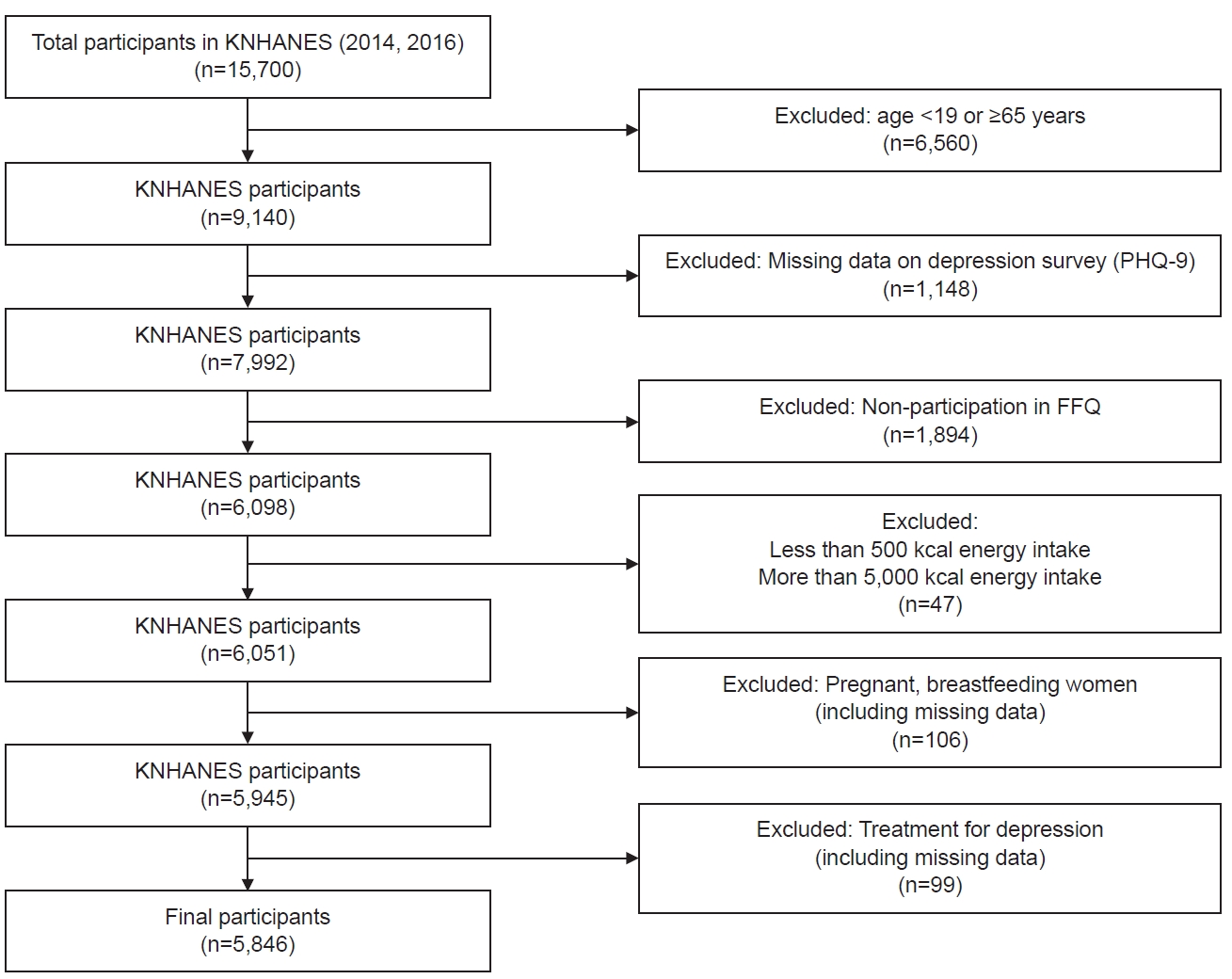
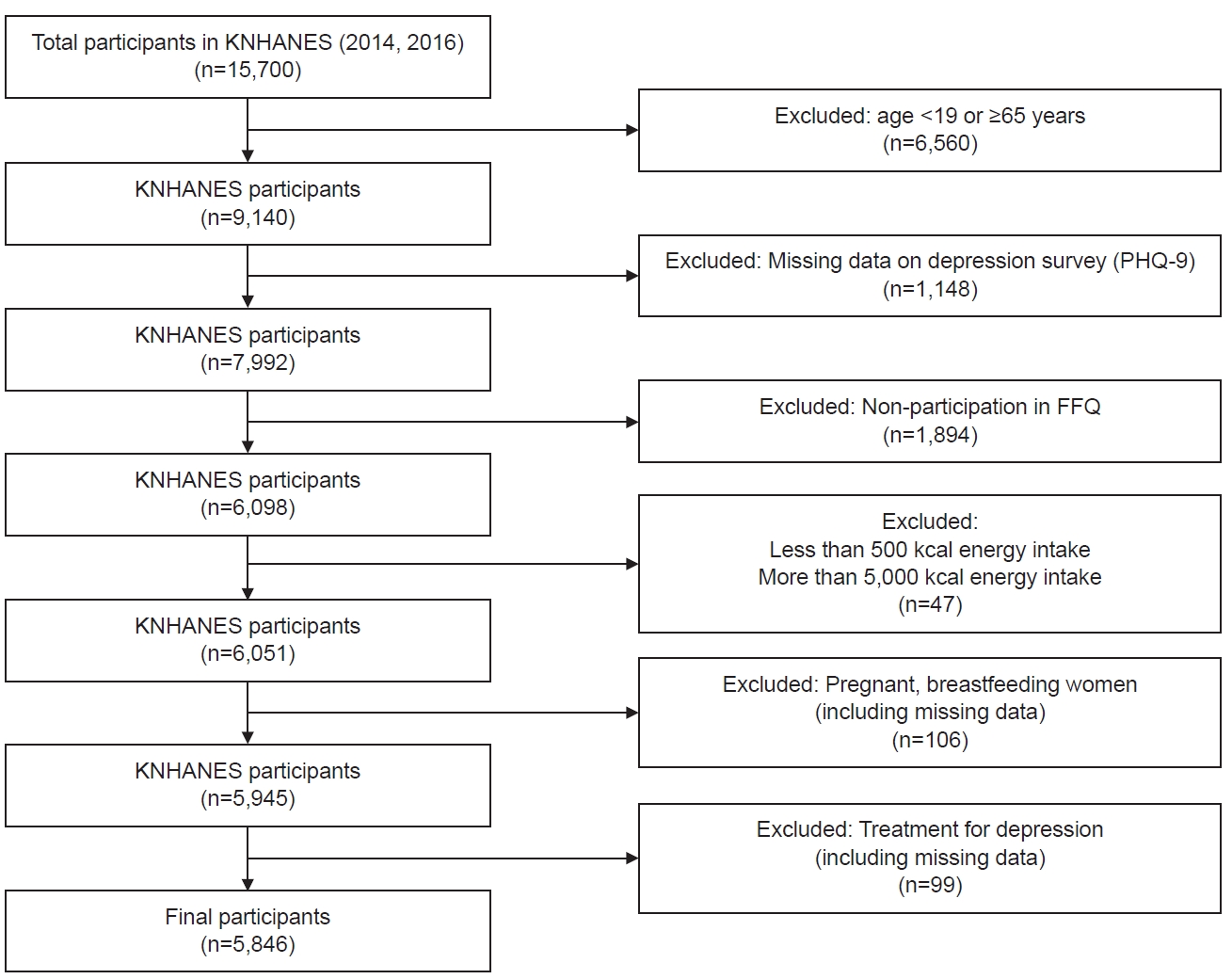
Among 15,700 survey participants, individuals were excluded sequentially according to the following criteria: age <19 or ≥65 years (n=6,560); missing or incomplete PHQ-9 (n=1,148) or FFQ data (n=1,894); implausible total energy intake (n=47); pregnancy or lactation (n=106); and current treatment for depression or nonresponse (n=99). After these exclusions, 5,846 participants were included in the final analysis (Fig. 1).
Variables
The primary outcome was depressive symptoms assessed using the PHQ-9, and the primary exposures were PDI, hPDI, and uPDI. Covariates included sociodemographic characteristics (sex, age, marital status, household size, education level, employment status, and household income), lifestyle factors (physical activity, smoking status, alcohol consumption, and body mass index [BMI]), clinical conditions (diabetes, hypertension, and CVD), and total daily energy intake.
Sociodemographic data were collected through interviews conducted by trained personnel. Physical activity was classified as sufficient (≥150 min/wk of moderate activity, ≥75 min/wk of vigorous activity, or an equivalent combination) or insufficient. Alcohol consumption was categorized as a nondrinker or drinker based on lifetime drinking experience and drinking frequency over the past year. BMI (kg/m²) was categorized as underweight (<18.5 kg/m²), normal weight (18.5 to <23.0 kg/m²), overweight (23.0 to <25.0 kg/m²), or obese (≥25.0 kg/m²).
For descriptive analyses, household income and BMI were presented as categorical variables (income quartiles and BMI categories), but both were treated as continuous variables in regression models. Diabetes was defined as fasting plasma glucose ≥126 mg/dL, use of antihyperglycemic medication or insulin, or a physician diagnosis. Hypertension was defined as systolic blood pressure ≥140 mmHg, diastolic blood pressure ≥90 mmHg, or use of antihypertensive medication. CVD included physician-diagnosed stroke, myocardial infarction, or angina. Total daily energy intake (kcal/day) was calculated from FFQ data and analyzed as a continuous variable.
Data sources

Assessment of depressive symptoms (outcome)

Depressive symptoms were assessed using the PHQ-9, administered as part of the KNHANES health questionnaire. The PHQ-9 is a 9-item tool based on the Diagnostic and Statistical Manual of Mental Disorders, Fourth Edition (DSM-IV) criteria. Participants rated their symptoms over the past two weeks on a 4-point scale ranging from 0 (“not at all”) to 3 (“nearly every day”). Total scores range from 0 to 27, with higher scores indicating greater severity of depressive symptoms. In this study, the PHQ-9 total score was analyzed as a continuous variable. Additionally, depressive symptoms were defined as a PHQ-9 score ≥10, a clinically validated cutoff with 88% sensitivity and 88% specificity [15], and were analyzed as a binary outcome.

Dietary assessment and plant-based diet indices (exposure)

Dietary intake was assessed using a validated 109-item semiquantitative FFQ administered in KNHANES [16]. Trained interviewers collected information on usual dietary intake over the previous year. For each item, participants reported consumption frequency using nine response categories and usual portion size per occasion based on standard portion options. Reported frequencies were converted to daily intakes (times/day) using the midpoint of each category, and daily intake was calculated by multiplying frequency by portion size (servings per occasion).
The primary exposure—overall PDI, hPDI, and uPDI—was calculated based on established methods [11], with minor modifications to reflect South Korean dietary patterns and the available FFQ items. Briefly, individual food items were grouped into 18 categories based on nutritional and culinary similarity, and further classified into healthy plant-based foods, less healthy plant-based foods, and animal foods. Healthy plant-based foods included whole grains, fruits, vegetables, nuts, legumes, tea and coffee, and fermented foods. Less healthy plant-based foods included fruit juices, refined grains, potatoes, sugar-sweetened beverages, and sweets and desserts. Animal-derived foods included animal fat, dairy, eggs, fish and seafood, meat, and others (Table S1).
Since sugar and cream added to coffee were assessed separately in the FFQ, plain tea and coffee were classified as healthy plant-based foods, added sugar as a less healthy plant-based food, and cream as an animal-derived food. A fermented foods group was created to reflect the high intake of kimchi and fermented soybean products in South Korean adults and was classified as a healthy plant-based food group based on emerging evidence suggesting potential benefits for depressive symptoms [17]. Vegetable oils were not included, as oil intake was not assessed in the FFQ.
Daily intakes for each food group were summed and energy-adjusted using the nutrient density method (per 1,000 kcal) [18]. Participants were assigned quintile-based scores (1–5) for each food group. For overall PDI, all plant-based foods were scored positively and animal-derived foods inversely. For hPDI, healthy plant-based foods were scored positively and less healthy plant-based foods inversely. For uPDI, less healthy plant-based foods were scored positively and healthy plant-based foods inversely. Scores across all 18 food groups were summed to generate each index, with a theoretical range of 18 to 90. Diet indices were categorized into tertiles to ensure adequate sample size in each category while maintaining variability for trend analysis. Continuous analyses (per 10-point increment) were also conducted to preserve statistical power and assess dose-response relationships.
Statistical analysis
All analyses used survey-weighted procedures to account for the complex, multistage probability sampling design. Sampling weights, stratification, and clustering were incorporated to produce nationally representative estimates and valid variance estimates for the South Korean population. Participant characteristics across overall tertiles of overall PDI are presented as numbers and percentages for categorical variables and weighted means with standard errors for continuous variables. Group differences were assessed using the Rao-Scott χ² test for categorical variables and weighted linear regression for continuous variables.
Survey-weighted linear regression was used to examine associations with PHQ-9 scores, and survey-weighted logistic regression was used for depressive symptoms defined by the PHQ-9 cutoff. Diet indices were analyzed both as tertiles and as a continuous variable (per 10-point increment). Results were presented as β-coefficients for linear regression and odds ratios for logistic regression, each with 95% confidence intervals (95% CIs). Linear trends across tertiles were assessed by modeling the median value of each tertile as a continuous variable.
Covariates were selected a priori to control for potential confounding, and sequentially adjusted models (Models 1–4) were fitted. Model 1 was unadjusted. Model 2 adjusted for age and sex. Model 3 additionally adjusted for household income, education level, marital status, household size, and employment status. Model 4 further adjusted for physical activity, smoking status, alcohol consumption, BMI, diabetes, hypertension, CVD, and total energy intake. To improve model stability, some variables were dichotomized before analysis: household size (living alone vs. with family) and education level (college or higher vs. high school or less). For descriptive purposes, household income and BMI were categorized, but both were treated as continuous variables in regression models.
Subgroup analyses were conducted by sex (male, female), age group (19–29, 30–49, 50–64 years), and obesity status (presence, absence) using the fully adjusted model (Model 4). Within each sex, differences in food group intake by depressive symptom status were assessed using survey-weighted linear regression. Statistical analyses were conducted using SAS ver. 9.4 (SAS Institute Inc.). All analyses were two-sided, and P <0.05 was considered statistically significant. Participants with missing covariate data were excluded (listwise deletion), and no imputation was performed.
Participants
Of the 15,700 individuals who participated in the KNHANES, 5,846 were eligible and included in the final analysis after sequential exclusions; the participant selection process is presented in Fig. 1.
Descriptive data
Participant characteristics by overall PDI tertiles are presented in Table 1. Compared with those in the lowest tertile, participants in the highest tertile were older and included higher proportions of women, married individuals, and employed individuals, whereas the proportions of college graduates, current smokers, and drinkers were lower. The highest tertile also had lower total energy intake and lower PHQ-9 scores, but a higher prevalence of diabetes, hypertension, and CVD. Household income, physical activity, and obesity status were similar across tertiles.
Outcome data
Of the 5,846 participants, 280 had depressive symptoms, defined as a PHQ-9 score ≥10.
Main results

Plant-based diet indices and depressive symptoms

Associations between plant-based diet indices and PHQ-9 scores are presented in Table 2. In fully adjusted models (Model 4), higher overall PDI and hPDI were associated with lower PHQ-9 scores, whereas higher uPDI was associated with higher PHQ-9 scores. Specifically, compared with the lowest tertile, participants in the highest tertile had lower PHQ-9 scores for overall PDI (β=−0.26; 95% CI, −0.50 to −0.02) and hPDI (β=−0.32; 95% CI, −0.63 to −0.01), while uPDI showed a positive association (β=0.29; 95% CI, 0.03 to 0.55). Trend tests across tertiles were statistically significant for all three indices in Model 4 (P-trend=0.031 for overall PDI; 0.042 for hPDI; 0.029 for uPDI). Similar results were observed when PDIs were analyzed as continuous variables: per 10-unit increases in overall PDI and hPDI were inversely associated with PHQ-9 scores, whereas uPDI was positively associated (Table 2).
Associations between PDIs and the odds of depressive symptoms are shown in Table 3. In Model 4, the inverse association for overall PDI was attenuated in the tertile comparison (T3 vs. T1: OR, 0.72; 95% CI, 0.49 to 1.07; P-trend=0.107), but remained significant when modeled continuously (per 10-unit increment: OR, 0.67; 95% CI, 0.50 to 0.89). For hPDI, inverse associations observed in less adjusted models were no longer statistically significant after full adjustment. In contrast, uPDI showed a positive association in Models 1–3, but this was attenuated and became nonsignificant in Model 4 (T3 vs. T1: OR, 1.49; 95% CI, 0.97 to 2.28; P-trend=0.059; per 10-unit increment: OR, 1.23; 95% CI, 0.99 to 1.54) (Table 3). Collectively, higher overall PDI and hPDI were associated with lower PHQ-9 scores, whereas higher uPDI was associated with higher scores; corresponding associations with depressive symptoms were in the same direction but weaker after full adjustment.

Subgroup analyses

In subgroup analyses, by sex, overall PDI showed an inverse trend across tertiles in males, whereas hPDI showed an inverse trend in females; uPDI showed no clear trend in either sex. When stratified by age group, an inverse trend for overall PDI was observed among participants aged 30–49 years, but not in those aged 19–29 or 50–64 years; no consistent trends were observed for hPDI or uPDI across age groups. By obesity status, hPDI showed an inverse trend in participants with obesity, whereas uPDI showed a positive trend in those without obesity (Table 4). Overall, these findings indicated that associations between plant-based diet indices and depressive symptoms vary across subgroups and are not uniform.

Food group intake differences by depressive symptoms

Sex-stratified comparisons of food group intake by depressive symptom status are shown in Table 5. Among males, those with depressive symptoms consumed lower amounts of healthy plant-based foods—particularly whole grains, fruits, vegetables, and nuts—compared with those without depressive symptoms; lower intakes were also observed for fruit juices and potatoes. Intakes of refined grains, sweets and desserts, and most animal-derived foods were similar between groups.
Among females, those with depressive symptoms also had lower intakes of whole grains, fruits, and vegetables, along with lower fruit juice consumption. In addition, female participants reported higher intake of sugar-sweetened beverages, sweets and desserts, refined grains, and animal fat. Most other food groups—including nuts, legumes, tea/coffee, fermented foods, and most animal foods—did not differ meaningfully by depressive symptom status. Overall, depressive symptoms were consistently associated with lower intakes of key healthy plant-based foods in both sexes, whereas differences in less healthy plant-based foods and some animal-derived foods were more evident among females.
This study used KNHANES data to examine the association between plant-based diet indices and depressive symptoms among South Korean adults. Higher overall PDI and hPDI scores were associated with lower PHQ-9 scores, whereas higher uPDI scores were associated with higher PHQ-9 scores. These associations remained after adjusting for sociodemographic factors, lifestyle behaviors, clinical characteristics, and total energy intake. Similarly, higher overall PDI and hPDI scores were associated with lower odds of depressive symptoms, while higher uPDI scores were associated with higher odds; however, some associations were attenuated and no longer statistically significant after full adjustment.
To date, relatively few studies have examined plant-based diet indices in relation to depression, and the available evidence is largely limited to specific populations [12,13]. In a large prospective cohort from the UK Biobank, overall PDI was not associated with depression risk, whereas hPDI and uPDI showed inverse and positive associations, respectively [12]. Similarly, an analysis of US National Health and Nutrition Examination Survey data reported no clear association for overall PDI, while higher hPDI was associated with lower odds of depressive symptoms and lower PHQ-9 scores, and higher uPDI was associated with higher odds and higher scores [13]. In contrast, the present study demonstrated significant associations for all three plant-based diet indices and PHQ-9 scores, with generally consistent directions for depressive symptoms.
One possible explanation for these differences is variation in how plant-based diet indices are constructed. Most previous studies have applied indices developed in Western dietary contexts [11-13,19], whereas Asian dietary patterns—particularly in South Korea—are typically centered on rice with diverse side dishes. In South Korea, traditional fermented foods, such as kimchi and fermented soybean products, are consumed in substantial amounts (155.4 g/day in men and 105.5 g/day in women), warranting separate consideration in food classification [20,21]. Previous South Korean studies have often grouped these foods as “salty foods” and classified them as less healthy due to their sodium content and associations with chronic diseases [19,20]. In contrast, we classified them as healthy plant-based foods, considering their dietary importance and emerging evidence suggesting that fermentation-derived components may modulate gut microbiota and immune-inflammatory pathways relevant to mental health [17]. While sodium reduction remains an important public health priority [19,20], our approach provides a complementary perspective by incorporating potential benefits of fermented foods. Nevertheless, these findings should be interpreted with caution, as differences in index construction may partly explain variations in results. A clear understanding of how individual food groups contribute to disease risk, along with further evaluation of alternative scoring approaches, may help refine dietary recommendations [22].
In this study, hPDI was inversely associated with PHQ-9 scores and depressive symptoms, whereas uPDI showed positive associations. Notably, overall PDI also demonstrated an inverse association, suggesting that the benefits of healthy plant-based foods may substantially offset the potential harms of less healthy plant-based foods within the overall diet. These findings indicate that while increasing plant-based food intake may be beneficial, the quality of plant-based foods is likely more important for the prevention of depressive symptoms and the promotion of mental health. Accordingly, dietary strategies for mental health promotion should emphasize the selection of high-quality plant-based foods. Beyond mental health, adherence to a high-quality plant-based diet has also been associated with favorable long-term health outcomes. For example, a large prospective cohort study reported that higher hPDI was associated with lower risks of cancer, CVD, and type 2 diabetes, as well as a reduced likelihood of multimorbidity [22].
Several plausible mechanisms may explain the observed associations. First, the abundance of antioxidants and bioactive compounds in healthy plant-based foods may protect against depressive symptoms by reducing oxidative stress and modulating inflammation-related pathways. Plant-derived phytochemicals, particularly polyphenols found in fruits and vegetables, can inhibit the nuclear factor kappa B signaling pathway, thereby decreasing the production of pro-inflammatory cytokines and alleviating neuroinflammation, which may help improve depressive symptoms [5]. Second, a healthy plant-based diet is typically high in dietary fiber, which can influence the diversity and composition of the gut microbiota. Nondigestible carbohydrates are fermented by gut microbes to produce short-chain fatty acids, which play a role in regulating immune function and reducing systemic inflammation [23]. In this study, we classified fermented foods as healthy plant-based foods, given their potential to promote beneficial gut bacteria, including butyrate-producing species, and to contribute to anti-inflammatory effects. However, clinical evidence supporting the effects of fermented foods on depressive symptoms remains limited, with existing studies suggesting only modest benefits [17]. These mechanisms are broadly consistent with evidence from plant-based dietary patterns, including the Mediterranean diet, for which meta-analysis of randomized controlled trials has shown reductions in depressive symptoms, potentially mediated by improvements in gut microbiota and reductions in inflammation and oxidative stress [24].
Differences between male and female participants may reflect underlying biological, hormonal, and social factors that influence both psychological and physiological responses to diet [25]. As shown in Table 5, both sexes with depressive symptoms consumed lower intakes of healthy plant-based foods, particularly whole grains, fruits, and vegetables, indicating poorer overall diet quality. However, female participants with depressive symptoms also reported higher intakes of refined grains, sugar-sweetened beverages, and desserts, suggesting a greater contrast in diet quality. This pattern may help explain why the association between hPDI and depressive symptoms was more common in females. In contrast, among males, the pattern seemed to be driven mainly by lower intakes of healthy plant-based foods rather than higher intakes of less healthy foods, which may partly explain the stronger association observed for overall PDI, an index reflecting overall plant-based food consumption.
Participants with depressive symptoms also shown distinct food intake patterns (Table 5). Female participants with depressive symptoms reported higher tea or coffee consumption, which may reflect greater reliance on caffeinated beverages to cope with fatigue or low energy; however, causal direction cannot be determined in this cross-sectional analysis [26]. Male participants with depressive symptoms consumed fewer potatoes than those without depressive symptoms. Although this may relate to reduced motivation affecting the selection of foods that require more preparation [27], the reasons for lower potato intake in such participants remain unclear. Additionally, differences in certain food categories may be difficult to interpret, as these foods can vary widely in form, ranging from raw to highly processed products.
Age-stratified analyses showed a significant inverse association between overall PDI and depressive symptoms only among participants aged 30 to 49 years. Conversely, among those aged 50 to 64 years, both overall PDI and uPDI were positively associated with depressive symptoms. Among young adults aged 19 to 29 years, overall PDI and uPDI showed inverse associated with depressive symptoms—a pattern that differed from other age groups—whereas hPDI showed a positive association.
In the context of negative emotional states, such as stress, the consumption of highly palatable, energy-dense foods may serve as a coping mechanism that temporarily reduces unpleasant feelings [28]. Prior research suggests that comfort eating may weaken the link between adverse life events and perceived stress, particularly among individuals with relatively low levels of depressive symptoms [28]. In young adults, irregular eating patterns and meal skipping [29] may contribute to higher uPDI scores through greater reliance on convenience foods and snacks as meal substitutes. Given that meal skipping has been associated with depression [29], this may partly explain the observed inverse association. In addition, differences in food choice patterns across age groups may have contributed to the heterogeneity in the observed associations.
In analyses stratified by obesity status, higher hPDI was significantly associated with lower odds of depressive symptoms in individuals with obesity, whereas higher uPDI was significantly associated with increased odds in those without obesity. The inverse association between hPDI and depressive symptoms in the obese group may be partly explained by shared oxidative stress pathways involved in both obesity and depression [30]. Antioxidant-rich plant-based foods may help reduce obesity-related low-grade inflammation, thereby contributing to improved mental health. However, subgroup differences in sample size and estimate precision may have influenced statistical significance, and the cross-sectional design limits causal inference.
Limitations
This study has several limitations. First, its cross-sectional design precludes causal inference, as the temporal relationship between plant-based diet indices and depressive symptoms cannot be established. Bidirectional associations and reverse causality cannot be excluded, and incident risk could not be assessed without longitudinal follow-up. Second, dietary intake was assessed using an interviewer-administered FFQ and may be subject to recall bias, potentially leading to nondifferential misclassification and attenuation of associations. In addition, dietary assessment was conducted at a single time point, limiting the ability to capture long-term dietary patterns. Depressive symptoms were assessed using the self-administered PHQ-9 and may be influenced by reporting bias or differences in interpretation. Third, the classification of fermented foods as healthy plant-based foods differs from the original PDI framework and may have influenced the observed associations. Given the high consumption of fermented foods in South Korea, this classification may have contributed to the overall pattern of associations in this study. Sensitivity analyses using alternative classifications (e.g., treating fermented foods as less healthy plant-based foods) were not performed in this study and should be considered in future studies. Fourth, selection and analytical biases are possible. Participants with missing covariate data were excluded (listwise deletion), and no imputation was performed. However, as missing data were minimal (<5%), substantial bias is unlikely. Although we adjusted for a wide range of covariates, residual confounding by unmeasured factors cannot be excluded. Finally, subgroup analyses may have been underpowered due to smaller sample sizes within strata, and nonsignificant findings should be interpreted with caution. While the findings are generalizable to South Korean adults aged 19 to 64 years, it may not extend to other age groups or populations with different dietary patterns.
Despite these limitations, this study uses nationally representative data and provides, to our knowledge, some of the first evidence in South Korea linking the quality of plant-based dietary patterns with depressive symptoms. By focusing on overall dietary quality rather than individual nutrients, these findings offer a more comprehensive and practice perspective on the potential role of plant-based diets in mental health among South Korean adults.
Conclusion
In conclusion, higher overall PDI and hPDI, along with lower uPDI, were associated with lower depressive symptom severity as measured by PHQ-9 scores. Although these associations remained directionally consistent, they were attenuated after full adjustment. Overall, these findings highlight the importance of plant-based diet quality—emphasizing healthy rather than less healthy plant-based foods—rather than simply increasing total plant-food intake among South Korean adults.

Authors’ contributions

Conceptualization: all authors. Data curation: SP. Formal analysis: SP. Supervision: YJP. Visualization: SP. Funding acquisition: YJP. Writing–original draft: SP. Writing–review & editing: all authors. All authors read and approved the final manuscript.

Conflicts of interest

None.

Funding

This work was supported by the National Research Foundation of Korea (RS-2025-00573031).

Data availability

The datasets analyzed in this study are available in the Korea National Health and Nutrition Examination Survey (KNHANES) repository, https://knhanes.kdca.go.kr/knhanes/main.do
Supplementary materials are available from https://doi.org/10.7762/cnr.2026.0007.

Supplementary Material S1.

Food groups included in the plant-based diet indices
cnr-2026-0007-Supplementary-Material-S1.pdf
Fig. 1.
Study participants selection flowchart. KNHANES, Korea National Health and Nutrition Examination Survey; PHQ-9, Patient Health Questionnaire-9; FFQ, food frequency questionnaire.
cnr-2026-0007f1.jpg
Table 1.
General characteristics of the participants across tertiles of overall PDI
Table 1.
Characteristic Overall PDI
Tertile 1 (n=1,722) Tertile 2 (n=1,850) Tertile 3 (n=2,274) P-valuea)
Score range 30–49 50–54 55–76 -
Age (yr) 36.60±0.37 40.76±0.41 44.93±0.32 <0.001
Sex
 Male 738 (54.6) 705 (49.8) 832 (46.6) <0.001
 Female 984 (45.4) 1,145 (50.2) 1,442 (53.4)
Marital status
 Married 1,214 (60.7) 1,476 (72.1) 1,954 (80.6) <0.001
 Unmarried 508 (39.3) 374 (27.9) 320 (19.4)
Household size
 Alone 131 (8.3) 133 (6.9) 137 (5.8) 0.099
 2–3 People 828 (47.6) 916 (48.5) 1,215 (50.1)
 ≥4 People 763 (44.0) 801 (44.6) 922 (44.1)
Education level
 ≤Elementary 83 (3.5) 172 (6.7) 290 (9.4) <0.001
 Middle 104 (5.3) 151 (6.5) 252 (9.8)
 High 684 (43.6) 718 (40.7) 803 (36.9)
 ≥College 851 (47.7) 809 (46.1) 927 (43.9)
Employment status
 Employed 1,119 (66.3) 1,240 (68.8) 1,554 (70.6) 0.036
 Unemployed 603 (33.7) 609 (31.2) 720 (29.4)
Household income (million KRW)d)
 <1 110 (7.2) 102 (4.8) 142 (5.6) 0.299
 1–2 198 (11.1) 217 (11.2) 292 (11.5)
 2–4 549 (32.3) 588 (31.7) 727 (32.3)
 >4 863 (49.5) 942 (52.4) 1,107 (50.5)
Physical activityb)
 Insufficiently active 818 (43.7) 862 (43.7) 1,071 (44.4) 0.920
 Sufficiently active 902 (56.3) 988 (56.3) 1,202 (55.6)
Smoking status
 Ex, nonsmoker 1,310 (71.4) 1,500 (76.4) 1,918 (81.0) <0.001
 Current smoker 409 (28.6) 344 (23.6) 351 (19.0)
Alcohol drinking statusc)
 Nondrinker 564 (28.3) 745 (35.7) 1,109 (45.1) <0.001
 Drinker 1,155 (71.7) 1,099 (64.3) 1,161 (54.9)
Body mass index (kg/m²)d)
 Classification of obesitye)
  Underweight 81 (4.7) 93 (5.0) 88 (3.9) 0.543
  Normal 761 (42.9) 744 (39.9) 939 (41.3)
  Overweight 361 (21.7) 423 (22.3) 519 (22.2)
  Obesity 519 (30.7) 588 (32.8) 727 (32.5)
Energy intake (kcal/day) 2,168.87±23.15 2,054.48±22.10 1,950.09±19.34 <0.001
Diabetes
 No 1,541 (95.6) 1,630 (93.7) 1,979 (91.5) <0.001
 Yes 81 (4.4) 128 (6.3) 197 (8.5)
Hypertension
 No 1,455 (85.4) 1,505 (83.0) 1,731 (77.4) <0.001
 Yes 264 (14.6) 343 (17.0) 541 (22.6)
CVD
 No 1,708 (99.5) 1,820 (99.0) 2,211 (97.6) <0.001
 Yes 14 (0.5) 30 (1.0) 63 (2.4)
PHQ-9 score 2.73±0.10 2.56±0.09 2.27±0.08 <0.001

Values are presented as mean±standard error or unweighted number (weighted percentage). Values are presented as mean±standard error or number (%). Missing data were <5% for all covariates. Specifically, missing values were observed for education level (n=2), employment status (n=1), household income (n=9), physical activity (n=3), smoking status (n=14), alcohol consumption (n=13), body mass index (n=3), diabetes (n=290), and hypertension (n=7); all other variables had complete data.

PDI, plant-based diet index; KRW, South Korean Won; CVD, cardiovascular disease; PHQ-9, Patient Health Questionnaire-9.

a)P-values were calculated using the PROC SURVEYFREQ (Rao-Scott χ² test) and PROC SURVEYREG.

b)Physical activity was categorized as sufficient (≥150 min/week of moderate activity, ≥75 min/wk of vigorous activity, or an equivalent combination) or insufficient (not meeting these criteria).

c)Alcohol consumption was defined as ≥1 drink per month during the past year.

d)Variables were categorized for descriptive purposes in this table but treated as continuous or binary variables in the regression analyses.

e)Body mass index categories were defined as follows: underweight (<18.5 kg/m²), normal (18.5 to <23.0 kg/m²), overweight (23.0 to <25.0 kg/m²), and obese (≥25.0 kg/m²).

Table 2.
Association between plant-based diet indices and PHQ-9 scores
Table 2.
Model Per 10-unit increment P-trenda) β-coefficient (95% CI) P-valuea)
Tertile 1 Tertile 2 Tertile 3 β-coefficient (95% CI)
Overall PDI
 Model 1 0 (Reference) −0.16 (−0.41 to 0.08) −0.46 (−0.70 to −0.22) <0.001 −0.38 (−0.57 to −0.20) <0.001
 Model 2 0 (Reference) −0.12 (−0.36 to 0.13) −0.35 (−0.60 to −0.11) 0.004 −0.31 (−0.50 to −0.12) 0.001
 Model 3 0 (Reference) −0.08 (−0.33 to 0.16) −0.33 (−0.57 to −0.08) 0.007 −0.29 (−0.48 to −0.10) 0.002
 Model 4 0 (Reference) −0.11 (−0.36 to 0.13) −0.26 (−0.50 to −0.02) 0.031 −0.23 (−0.41 to −0.04) 0.017
hPDI
 Model 1 0 (Reference) −0.34 (−0.59 to −0.10) −0.49 (−0.73 to −0.25) <0.001 −0.21 (−0.32 to −0.10) <0.001
 Model 2 0 (Reference) −0.29 (−0.55 to −0.03) −0.40 (−0.69 to −0.11) 0.008 −0.18 (−0.31 to −0.04) 0.010
 Model 3 0 (Reference) −0.25 (−0.51 to 0.01) −0.41 (−0.70 to −0.12) 0.006 −0.19 (−0.33 to −0.06) 0.005
 Model 4 0 (Reference) −0.22 (−0.49 to 0.05) −0.32 (−0.63 to −0.01) 0.042 −0.16 (−0.30 to −0.02) 0.025
uPDI
 Model 1 0 (Reference) 0.15 (−0.07 to 0.37) 0.37 (0.12 to 0.61) 0.003 0.26 (0.13 to 0.39) <0.001
 Model 2 0 (Reference) 0.24 (0.02 to 0.47) 0.47 (0.20 to 0.73) <0.001 0.33 (0.19 to 0.48) <0.001
 Model 3 0 (Reference) 0.21 (−0.01 to 0.43) 0.35 (0.08 to 0.61) 0.011 0.25 (0.11 to 0.40) <0.001
 Model 4 0 (Reference) 0.22 (0.00 to 0.44) 0.29 (0.03 to 0.55) 0.029 0.21 (0.07 to 0.35) 0.003

Model 1, crude model; Model 2, adjusted for age (continuous) and sex; Model 3, further adjusted for average monthly household income (continuous), education level, marital status, household size, and employment status; Model 4, additionally adjusted for physical activity, smoking status, alcohol consumption, body mass index (continuous), diabetes, hypertension, cardiovascular disease, and total energy intake (continuous).

PHQ-9, Patient Health Questionnaire-9; CI, confidence interval; PDI, plant-based diet index; hPDI, healthful plant-based diet index; uPDI, unhealthful plant-based diet index.

a)P-values and P-trend were obtained using survey-weighted linear regression (PROC SURVEYREG). P for trend was calculated by assigning the median value of each tertile and modeling it as a continuous variable.

Table 3.
Associations of plant-based diet indices with depressive symptoms
Table 3.
Model Per 10-unit increment P-trenda) OR (95% CI) P-valuea)
Tertile 1 Tertile 2 Tertile 3 OR (95% CI)
Overall PDI
 Model 1 1 (Reference) 0.87 (0.62 to 1.23) 0.65 (0.45 to 0.93) 0.019 0.63 (0.48 to 0.81) <0.001
 Model 2 1 (Reference) 0.88 (0.62 to 1.25) 0.66 (0.46 to 0.97) 0.032 0.62 (0.47 to 0.82) <0.001
 Model 3 1 (Reference) 0.91 (0.64 to 1.30) 0.69 (0.47 to 1.01) 0.053 0.64 (0.48 to 0.84) 0.001
 Model 4 1 (Reference) 0.87 (0.59 to 1.29) 0.72 (0.49 to 1.07) 0.107 0.67 (0.50 to 0.89) 0.006
hPDI
 Model 1 1 (Reference) 0.79 (0.58 to 1.07) 0.71 (0.51 to 0.98) 0.041 0.89 (0.76 to 1.04) 0.129
 Model 2 1 (Reference) 0.78 (0.56 to 1.07) 0.68 (0.46 to 1.01) 0.057 0.88 (0.73 to 1.06) 0.179
 Model 3 1 (Reference) 0.80 (0.58 to 1.11) 0.63 (0.41 to 0.95) 0.026 0.85 (0.70 to 1.02) 0.081
 Model 4 1 (Reference) 0.84 (0.59 to 1.19) 0.71 (0.45 to 1.12) 0.141 0.87 (0.71 to 1.07) 0.194
uPDI
 Model 1 1 (Reference) 1.01 (0.69 to 1.47) 1.52 (1.08 to 2.14) 0.013 1.32 (1.10 to 1.58) 0.002
 Model 2 1 (Reference) 1.11 (0.74 to 1.65) 1.76 (1.17 to 2.64) 0.005 1.44 (1.17 to 1.79) 0.001
 Model 3 1 (Reference) 1.10 (0.74 to 1.63) 1.61 (1.07 to 2.44) 0.019 1.35 (1.09 to 1.67) 0.006
 Model 4 1 (Reference) 1.14 (0.76 to 1.71) 1.49 (0.97 to 2.28) 0.059 1.23 (0.99 to 1.54) 0.058

Model 1, crude model; Model 2, adjusted for age (continuous) and sex; Model 3, further adjusted for average monthly household income (continuous), education level, marital status, household size, and employment status; Model 4, additionally adjusted for physical activity, smoking status, alcohol consumption, body mass index (continuous), diabetes and hypertension, cardiovascular disease, and total energy intake (continuous).

OR, odds ratio; CI, confidence interval; PDI, plant-based diet index; hPDI, healthful plant-based diet index; uPDI, unhealthful plant-based diet index.

a)P-values and P-trend were obtained using survey-weighted logistic regression (PROC SURVEYLOGISTIC). P-trend was calculated by assigning the median value of each tertile and modeling it as a continuous variable.

Table 4.
Subgroup analyses of the associations between plant-based diet indices and depressive symptoms by sex, age, and obesity status (n=5,846)
Table 4.
Characteristic No. of patients Tertiles of overall PDI Tertiles of hPDI Tertiles of uPDI
Tertile 2 Tertile 3 P-trenda) Tertile 2 Tertile 3 P-trenda) Tertile 2 Tertile 3 P-trenda)
Sex
 Male 2,275 0.59 (0.29 to 1.21) 0.44 (0.22 to 0.89) 0.022 0.87 (0.45 to 1.68) 0.99 (0.41 to 2.37) 0.927 1.01 (0.39 to 2.65) 1.51 (0.57 to 3.97) 0.277
 Female 3,571 1.12 (0.72 to 1.73) 0.94 (0.59 to 1.49) 0.744 0.79 (0.52 to 1.20) 0.58 (0.35 to 0.99) 0.043 1.16 (0.75 to 1.79) 1.43 (0.89 to 2.32) 0.143
Age (yr)
 19–29 917 1.08 (0.54 to 2.16) 0.85 (0.35 to 2.03) 0.765 0.92 (0.46 to 1.84) 1.31 (0.48 to 3.58) 0.770 0.42 (0.15 to 1.14) 0.76 (0.29 to 1.99) 0.906
 30–49 2,824 0.77 (0.45 to 1.33) 0.38 (0.21 to 0.66) <0.001 0.88 (0.54 to 1.44) 0.56 (0.28 to 1.10) 0.093 1.36 (0.76 to 2.44) 1.60 (0.90 to 2.85) 0.109
 50–64 2,105 1.05 (0.52 to 2.14) 1.36 (0.68 to 2.72) 0.340 0.43 (0.17 to 1.06) 0.40 (0.17 to 0.96) 0.188 1.28 (0.66 to 2.48) 1.92 (0.96 to 3.85) 0.074
Obesity statusb)
 Absence 4,012 0.94 (0.61 to 1.45) 0.80 (0.50 to 1.28) 0.347 0.84 (0.54 to 1.31) 0.88 (0.50 to 1.52) 0.634 1.25 (0.76 to 2.04) 1.75 (1.03 to 2.99) 0.035
 Presence 1,834 0.68 (0.33 to 1.40) 0.49 (0.24 to 1.00) 0.051 0.80 (0.41 to 1.57) 0.40 (0.17 to 0.94) 0.029 0.97 (0.46 to 2.06) 1.09 (0.50 to 2.40) 0.830

Values are presented as OR (95% CI). The lowest tertile (Tertile 1) served as the reference category (OR, 1.00). All subgroup analyses used the fully adjusted Model 4, with the stratification variable excluded from the adjustment set.

PDI, plant-based diet index; hPDI, healthful plant-based diet index; uPDI, unhealthful plant-based diet index; OR, odds ratio; CI, confidence interval.

a)P-trend was obtained using survey-weighted logistic regression (PROC SURVEYLOGISTIC); P-trend was calculated by assigning the median value of each tertile and modeling it as a continuous variable.

b)Obesity status was defined as body mass index <25.0 kg/m² (absence) and ≥25.0 kg/m² (presence).

Table 5.
Sex-stratified comparison of food categories by depressive symptom status
Table 5.
Variable Male Female
Nondepressed Depressed P-valuea) Nondepressed Depressed P-valuea)
Healthy plant-based foods
 Whole grains 0.466±0.010 0.366±0.050 0.048 0.623±0.010 0.523±0.042 0.021
 Fruits 0.393±0.011 0.225±0.031 <0.001 0.777±0.014 0.643±0.046 0.006
 Vegetables 1.007±0.016 0.733±0.067 <0.001 1.456±0.021 1.244±0.077 0.008
 Nuts 0.035±0.002 0.015±0.003 <0.001 0.047±0.002 0.042±0.011 0.606
 Legumes 0.135±0.004 0.108±0.018 0.147 0.163±0.004 0.157±0.018 0.725
 Tea and coffee 0.589±0.013 0.598±0.080 0.909 0.653±0.014 0.783±0.089 0.140
 Fermented foods 1.609±0.027 1.466±0.115 0.226 1.799±0.029 1.610±0.130 0.154
Less healthy plant-based foods
 Fruit juices 0.046±0.002 0.021±0.006 <0.001 0.034±0.002 0.022±0.004 0.006
 Refined grains 0.961±0.011 0.971±0.060 0.870 0.798±0.010 0.899±0.043 0.021
 Potatoes 0.053±0.002 0.028±0.004 <0.001 0.074±0.002 0.068±0.011 0.564
 Sugar-sweetened beverages 0.092±0.005 0.136±0.025 0.082 0.051±0.003 0.100±0.018 0.006
 Sweets and desserts 0.402±0.009 0.545±0.087 0.107 0.391±0.008 0.501±0.045 0.018
Animal-derived foods
 Animal fat 0.273±0.008 0.424±0.090 0.095 0.235±0.007 0.319±0.040 0.039
 Dairy 0.318±0.008 0.253±0.037 0.089 0.427±0.009 0.418±0.054 0.867
 Eggs 0.205±0.005 0.265±0.037 0.113 0.276±0.005 0.268±0.024 0.730
 Fish or seafood 0.333±0.008 0.319±0.041 0.741 0.444±0.013 0.387±0.039 0.172
 Meat 0.384±0.006 0.364±0.031 0.522 0.335±0.005 0.350±0.022 0.490
 Miscellaneous animal foodsb) 0.042±0.001 0.048±0.007 0.385 0.047±0.001 0.053±0.005 0.256

Values are presented as mean±standard error of energy-adjusted intake (servings/1,000 kcal). Depressive status was defined as Patient Health Questionnaire-9 (PHQ-9) scores ≥10 (depressed) and PHQ-9 scores <10 (nondepressed).

a)P-values were obtained using survey-weighted linear regression (PROC SURVEYREG).

b)Miscellaneous animal foods refer to mixed dishes containing animal-based ingredients that are difficult to assign to a single animal food group (e.g., dumplings, pizza, South Korean blood sausage).
  • 1. GBD 2021 Diseases and Injuries Collaborators. Global incidence, prevalence, years lived with disability (YLDs), disability-adjusted life-years (DALYs), and healthy life expectancy (HALE) for 371 diseases and injuries in 204 countries and territories and 811 subnational locations, 1990-2021: a systematic analysis for the Global Burden of Disease Study 2021. Lancet 2024;403:2133-61.
  • 2. Otte C, Gold SM, Penninx BW, et al. Major depressive disorder. Nat Rev Dis Primers 2016;2:16065.
  • 3. Organisation for Economic Co-operation and Development (OECD). Society at a glance 2024: OECD social indicators. OECD; 2024.
  • 4. Firth J, Solmi M, Wootton RE, et al. A meta-review of "lifestyle psychiatry": the role of exercise, smoking, diet and sleep in the prevention and treatment of mental disorders. World Psychiatry 2020;19:360-80.
  • 5. Marx W, Lane M, Hockey M, et al. Diet and depression: exploring the biological mechanisms of action. Mol Psychiatry 2021;26:134-50.
  • 6. Li Y, Lv MR, Wei YJ, et al. Dietary patterns and depression risk: a meta-analysis. Psychiatry Res 2017;253:373-82.
  • 7. Dinu M, Abbate R, Gensini GF, Casini A, Sofi F. Vegetarian, vegan diets and multiple health outcomes: a systematic review with meta-analysis of observational studies. Crit Rev Food Sci Nutr 2017;57:3640-9.
  • 8. Jain R, Larsuphrom P, Degremont A, Latunde-Dada GO, Philippou E. Association between vegetarian and vegan diets and depression: a systematic review. Nutr Bull 2022;47:27-49.
  • 9. Fazelian S, Sadeghi E, Firouzi S, Haghighatdoost F. Adherence to the vegetarian diet may increase the risk of depression: a systematic review and meta-analysis of observational studies. Nutr Rev 2022;80:242-54.
  • 10. Swaminathan S, Dehghan M, Raj JM, et al. Associations of cereal grains intake with cardiovascular disease and mortality across 21 countries in prospective urban and rural epidemiology study: prospective cohort study. BMJ 2021;372:m4948.
  • 11. Satija A, Bhupathiraju SN, Rimm EB, et al. Plant-based dietary patterns and incidence of type 2 diabetes in US men and women: results from three prospective cohort studies. PLoS Med 2016;13:e1002039.
  • 12. Wu H, Gu Y, Meng G, et al. Quality of plant-based diet and the risk of dementia and depression among middle-aged and older population. Age Ageing 2023;52:afad070.
  • 13. Zhang B, Li M, Li X. Plant-based diets especially healthy ones are negatively associated with depression: a cross-sectional study. BMC Public Health 2025;26:17.
  • 14. Hu FB. Diet strategies for promoting healthy aging and longevity: an epidemiological perspective. J Intern Med 2024;295:508-31.
  • 15. Kroenke K, Spitzer RL, Williams JB. The PHQ-9: validity of a brief depression severity measure. J Gen Intern Med 2001;16:606-13.
  • 16. Kim DW, Song S, Lee JE, et al. Reproducibility and validity of an FFQ developed for the Korea National Health and Nutrition Examination Survey (KNHANES). Public Health Nutr 2015;18:1369-77.
  • 17. Aslam H, Green J, Jacka FN, et al. Fermented foods, the gut and mental health: a mechanistic overview with implications for depression and anxiety. Nutr Neurosci 2020;23:659-71.
  • 18. Willett WC, Howe GR, Kushi LH. Adjustment for total energy intake in epidemiologic studies. Am J Clin Nutr 1997;65:1220S-1228S.
  • 19. Kim H, Lee K, Rebholz CM, Kim J. Association between unhealthy plant-based diets and the metabolic syndrome in adult men and women: a population-based study in South Korea. Br J Nutr 2021;125:577-90.
  • 20. Lee H, Lee JE, Kang M. Association of plant-based diet indices with all-cause and cause-specific mortality among Korean adults in the KNHANES. Sci Rep 2025;15:41007.
  • 21. Kim SY, Freeland-Graves JH, Kim HJ. Nineteen-year trends in fermented food consumption and sodium intake from fermented foods for Korean adults from 1998 to 2016. Public Health Nutr 2020;23:515-24.
  • 22. Cordova R, Kim J, Thompson AS, et al. Plant-based dietary patterns and age-specific risk of multimorbidity of cancer and cardiometabolic diseases: a prospective analysis. Lancet Healthy Longev 2025;6:100742.
  • 23. Taylor AM, Holscher HD. A review of dietary and microbial connections to depression, anxiety, and stress. Nutr Neurosci 2020;23:237-50.
  • 24. Bizzozero-Peroni B, Martinez-Vizcaino V, Fernandez-Rodriguez R, et al. The impact of the Mediterranean diet on alleviating depressive symptoms in adults: a systematic review and meta-analysis of randomized controlled trials. Nutr Rev 2025;83:29-39.
  • 25. Hyde JS. Gender similarities and differences. Annu Rev Psychol 2014;65:373-98.
  • 26. Lucas M, Mirzaei F, Pan A, et al. Coffee, caffeine, and risk of depression among women. Arch Intern Med 2011;171:1571-8.
  • 27. Opie R, Abbott G, Crawford D, Ball K. Exploring the associations of depressive symptoms with healthy eating self-efficacy over time amongst women in the READI cohort study. Int J Behav Nutr Phys Act 2021;18:161.
  • 28. Finch LE, Tomiyama AJ. Comfort eating, psychological stress, and depressive symptoms in young adult women. Appetite 2015;95:239-44.
  • 29. Lee EJ, Kim JM. Association between depression and eating behavior factors in Korean adults: The Korea National Health and Nutrition Examination Survey 2018. J Nutr Health 2021;54:152-64.
  • 30. Rigobon AV, Kanagasabai T, Taylor VH. Obesity moderates the complex relationships between inflammation, oxidative stress, sleep quality and depressive symptoms. BMC Obes 2018;5:32.

Download Citation

Download a citation file in RIS format that can be imported by all major citation management software, including EndNote, ProCite, RefWorks, and Reference Manager.

Format:

Include:

Association between plant-based diet indices and depressive symptoms among South Korean adults: a cross-sectional study using the 2014 and 2016 Korea National Health and Nutrition Examination Surveys
Clin Nutr Res. 2026;15(2):79-90.   Published online April 30, 2026
Download Citation

Download a citation file in RIS format that can be imported by all major citation management software, including EndNote, ProCite, RefWorks, and Reference Manager.

Format:
Include:
Association between plant-based diet indices and depressive symptoms among South Korean adults: a cross-sectional study using the 2014 and 2016 Korea National Health and Nutrition Examination Surveys
Clin Nutr Res. 2026;15(2):79-90.   Published online April 30, 2026
Close

Figure

  • 0
Association between plant-based diet indices and depressive symptoms among South Korean adults: a cross-sectional study using the 2014 and 2016 Korea National Health and Nutrition Examination Surveys
Image
Fig. 1. Study participants selection flowchart. KNHANES, Korea National Health and Nutrition Examination Survey; PHQ-9, Patient Health Questionnaire-9; FFQ, food frequency questionnaire.
Association between plant-based diet indices and depressive symptoms among South Korean adults: a cross-sectional study using the 2014 and 2016 Korea National Health and Nutrition Examination Surveys
Characteristic Overall PDI
Tertile 1 (n=1,722) Tertile 2 (n=1,850) Tertile 3 (n=2,274) P-valuea)
Score range 30–49 50–54 55–76 -
Age (yr) 36.60±0.37 40.76±0.41 44.93±0.32 <0.001
Sex
 Male 738 (54.6) 705 (49.8) 832 (46.6) <0.001
 Female 984 (45.4) 1,145 (50.2) 1,442 (53.4)
Marital status
 Married 1,214 (60.7) 1,476 (72.1) 1,954 (80.6) <0.001
 Unmarried 508 (39.3) 374 (27.9) 320 (19.4)
Household size
 Alone 131 (8.3) 133 (6.9) 137 (5.8) 0.099
 2–3 People 828 (47.6) 916 (48.5) 1,215 (50.1)
 ≥4 People 763 (44.0) 801 (44.6) 922 (44.1)
Education level
 ≤Elementary 83 (3.5) 172 (6.7) 290 (9.4) <0.001
 Middle 104 (5.3) 151 (6.5) 252 (9.8)
 High 684 (43.6) 718 (40.7) 803 (36.9)
 ≥College 851 (47.7) 809 (46.1) 927 (43.9)
Employment status
 Employed 1,119 (66.3) 1,240 (68.8) 1,554 (70.6) 0.036
 Unemployed 603 (33.7) 609 (31.2) 720 (29.4)
Household income (million KRW)d)
 <1 110 (7.2) 102 (4.8) 142 (5.6) 0.299
 1–2 198 (11.1) 217 (11.2) 292 (11.5)
 2–4 549 (32.3) 588 (31.7) 727 (32.3)
 >4 863 (49.5) 942 (52.4) 1,107 (50.5)
Physical activityb)
 Insufficiently active 818 (43.7) 862 (43.7) 1,071 (44.4) 0.920
 Sufficiently active 902 (56.3) 988 (56.3) 1,202 (55.6)
Smoking status
 Ex, nonsmoker 1,310 (71.4) 1,500 (76.4) 1,918 (81.0) <0.001
 Current smoker 409 (28.6) 344 (23.6) 351 (19.0)
Alcohol drinking statusc)
 Nondrinker 564 (28.3) 745 (35.7) 1,109 (45.1) <0.001
 Drinker 1,155 (71.7) 1,099 (64.3) 1,161 (54.9)
Body mass index (kg/m²)d)
 Classification of obesitye)
  Underweight 81 (4.7) 93 (5.0) 88 (3.9) 0.543
  Normal 761 (42.9) 744 (39.9) 939 (41.3)
  Overweight 361 (21.7) 423 (22.3) 519 (22.2)
  Obesity 519 (30.7) 588 (32.8) 727 (32.5)
Energy intake (kcal/day) 2,168.87±23.15 2,054.48±22.10 1,950.09±19.34 <0.001
Diabetes
 No 1,541 (95.6) 1,630 (93.7) 1,979 (91.5) <0.001
 Yes 81 (4.4) 128 (6.3) 197 (8.5)
Hypertension
 No 1,455 (85.4) 1,505 (83.0) 1,731 (77.4) <0.001
 Yes 264 (14.6) 343 (17.0) 541 (22.6)
CVD
 No 1,708 (99.5) 1,820 (99.0) 2,211 (97.6) <0.001
 Yes 14 (0.5) 30 (1.0) 63 (2.4)
PHQ-9 score 2.73±0.10 2.56±0.09 2.27±0.08 <0.001
Model Per 10-unit increment P-trenda) β-coefficient (95% CI) P-valuea)
Tertile 1 Tertile 2 Tertile 3 β-coefficient (95% CI)
Overall PDI
 Model 1 0 (Reference) −0.16 (−0.41 to 0.08) −0.46 (−0.70 to −0.22) <0.001 −0.38 (−0.57 to −0.20) <0.001
 Model 2 0 (Reference) −0.12 (−0.36 to 0.13) −0.35 (−0.60 to −0.11) 0.004 −0.31 (−0.50 to −0.12) 0.001
 Model 3 0 (Reference) −0.08 (−0.33 to 0.16) −0.33 (−0.57 to −0.08) 0.007 −0.29 (−0.48 to −0.10) 0.002
 Model 4 0 (Reference) −0.11 (−0.36 to 0.13) −0.26 (−0.50 to −0.02) 0.031 −0.23 (−0.41 to −0.04) 0.017
hPDI
 Model 1 0 (Reference) −0.34 (−0.59 to −0.10) −0.49 (−0.73 to −0.25) <0.001 −0.21 (−0.32 to −0.10) <0.001
 Model 2 0 (Reference) −0.29 (−0.55 to −0.03) −0.40 (−0.69 to −0.11) 0.008 −0.18 (−0.31 to −0.04) 0.010
 Model 3 0 (Reference) −0.25 (−0.51 to 0.01) −0.41 (−0.70 to −0.12) 0.006 −0.19 (−0.33 to −0.06) 0.005
 Model 4 0 (Reference) −0.22 (−0.49 to 0.05) −0.32 (−0.63 to −0.01) 0.042 −0.16 (−0.30 to −0.02) 0.025
uPDI
 Model 1 0 (Reference) 0.15 (−0.07 to 0.37) 0.37 (0.12 to 0.61) 0.003 0.26 (0.13 to 0.39) <0.001
 Model 2 0 (Reference) 0.24 (0.02 to 0.47) 0.47 (0.20 to 0.73) <0.001 0.33 (0.19 to 0.48) <0.001
 Model 3 0 (Reference) 0.21 (−0.01 to 0.43) 0.35 (0.08 to 0.61) 0.011 0.25 (0.11 to 0.40) <0.001
 Model 4 0 (Reference) 0.22 (0.00 to 0.44) 0.29 (0.03 to 0.55) 0.029 0.21 (0.07 to 0.35) 0.003
Model Per 10-unit increment P-trenda) OR (95% CI) P-valuea)
Tertile 1 Tertile 2 Tertile 3 OR (95% CI)
Overall PDI
 Model 1 1 (Reference) 0.87 (0.62 to 1.23) 0.65 (0.45 to 0.93) 0.019 0.63 (0.48 to 0.81) <0.001
 Model 2 1 (Reference) 0.88 (0.62 to 1.25) 0.66 (0.46 to 0.97) 0.032 0.62 (0.47 to 0.82) <0.001
 Model 3 1 (Reference) 0.91 (0.64 to 1.30) 0.69 (0.47 to 1.01) 0.053 0.64 (0.48 to 0.84) 0.001
 Model 4 1 (Reference) 0.87 (0.59 to 1.29) 0.72 (0.49 to 1.07) 0.107 0.67 (0.50 to 0.89) 0.006
hPDI
 Model 1 1 (Reference) 0.79 (0.58 to 1.07) 0.71 (0.51 to 0.98) 0.041 0.89 (0.76 to 1.04) 0.129
 Model 2 1 (Reference) 0.78 (0.56 to 1.07) 0.68 (0.46 to 1.01) 0.057 0.88 (0.73 to 1.06) 0.179
 Model 3 1 (Reference) 0.80 (0.58 to 1.11) 0.63 (0.41 to 0.95) 0.026 0.85 (0.70 to 1.02) 0.081
 Model 4 1 (Reference) 0.84 (0.59 to 1.19) 0.71 (0.45 to 1.12) 0.141 0.87 (0.71 to 1.07) 0.194
uPDI
 Model 1 1 (Reference) 1.01 (0.69 to 1.47) 1.52 (1.08 to 2.14) 0.013 1.32 (1.10 to 1.58) 0.002
 Model 2 1 (Reference) 1.11 (0.74 to 1.65) 1.76 (1.17 to 2.64) 0.005 1.44 (1.17 to 1.79) 0.001
 Model 3 1 (Reference) 1.10 (0.74 to 1.63) 1.61 (1.07 to 2.44) 0.019 1.35 (1.09 to 1.67) 0.006
 Model 4 1 (Reference) 1.14 (0.76 to 1.71) 1.49 (0.97 to 2.28) 0.059 1.23 (0.99 to 1.54) 0.058
Characteristic No. of patients Tertiles of overall PDI Tertiles of hPDI Tertiles of uPDI
Tertile 2 Tertile 3 P-trenda) Tertile 2 Tertile 3 P-trenda) Tertile 2 Tertile 3 P-trenda)
Sex
 Male 2,275 0.59 (0.29 to 1.21) 0.44 (0.22 to 0.89) 0.022 0.87 (0.45 to 1.68) 0.99 (0.41 to 2.37) 0.927 1.01 (0.39 to 2.65) 1.51 (0.57 to 3.97) 0.277
 Female 3,571 1.12 (0.72 to 1.73) 0.94 (0.59 to 1.49) 0.744 0.79 (0.52 to 1.20) 0.58 (0.35 to 0.99) 0.043 1.16 (0.75 to 1.79) 1.43 (0.89 to 2.32) 0.143
Age (yr)
 19–29 917 1.08 (0.54 to 2.16) 0.85 (0.35 to 2.03) 0.765 0.92 (0.46 to 1.84) 1.31 (0.48 to 3.58) 0.770 0.42 (0.15 to 1.14) 0.76 (0.29 to 1.99) 0.906
 30–49 2,824 0.77 (0.45 to 1.33) 0.38 (0.21 to 0.66) <0.001 0.88 (0.54 to 1.44) 0.56 (0.28 to 1.10) 0.093 1.36 (0.76 to 2.44) 1.60 (0.90 to 2.85) 0.109
 50–64 2,105 1.05 (0.52 to 2.14) 1.36 (0.68 to 2.72) 0.340 0.43 (0.17 to 1.06) 0.40 (0.17 to 0.96) 0.188 1.28 (0.66 to 2.48) 1.92 (0.96 to 3.85) 0.074
Obesity statusb)
 Absence 4,012 0.94 (0.61 to 1.45) 0.80 (0.50 to 1.28) 0.347 0.84 (0.54 to 1.31) 0.88 (0.50 to 1.52) 0.634 1.25 (0.76 to 2.04) 1.75 (1.03 to 2.99) 0.035
 Presence 1,834 0.68 (0.33 to 1.40) 0.49 (0.24 to 1.00) 0.051 0.80 (0.41 to 1.57) 0.40 (0.17 to 0.94) 0.029 0.97 (0.46 to 2.06) 1.09 (0.50 to 2.40) 0.830
Variable Male Female
Nondepressed Depressed P-valuea) Nondepressed Depressed P-valuea)
Healthy plant-based foods
 Whole grains 0.466±0.010 0.366±0.050 0.048 0.623±0.010 0.523±0.042 0.021
 Fruits 0.393±0.011 0.225±0.031 <0.001 0.777±0.014 0.643±0.046 0.006
 Vegetables 1.007±0.016 0.733±0.067 <0.001 1.456±0.021 1.244±0.077 0.008
 Nuts 0.035±0.002 0.015±0.003 <0.001 0.047±0.002 0.042±0.011 0.606
 Legumes 0.135±0.004 0.108±0.018 0.147 0.163±0.004 0.157±0.018 0.725
 Tea and coffee 0.589±0.013 0.598±0.080 0.909 0.653±0.014 0.783±0.089 0.140
 Fermented foods 1.609±0.027 1.466±0.115 0.226 1.799±0.029 1.610±0.130 0.154
Less healthy plant-based foods
 Fruit juices 0.046±0.002 0.021±0.006 <0.001 0.034±0.002 0.022±0.004 0.006
 Refined grains 0.961±0.011 0.971±0.060 0.870 0.798±0.010 0.899±0.043 0.021
 Potatoes 0.053±0.002 0.028±0.004 <0.001 0.074±0.002 0.068±0.011 0.564
 Sugar-sweetened beverages 0.092±0.005 0.136±0.025 0.082 0.051±0.003 0.100±0.018 0.006
 Sweets and desserts 0.402±0.009 0.545±0.087 0.107 0.391±0.008 0.501±0.045 0.018
Animal-derived foods
 Animal fat 0.273±0.008 0.424±0.090 0.095 0.235±0.007 0.319±0.040 0.039
 Dairy 0.318±0.008 0.253±0.037 0.089 0.427±0.009 0.418±0.054 0.867
 Eggs 0.205±0.005 0.265±0.037 0.113 0.276±0.005 0.268±0.024 0.730
 Fish or seafood 0.333±0.008 0.319±0.041 0.741 0.444±0.013 0.387±0.039 0.172
 Meat 0.384±0.006 0.364±0.031 0.522 0.335±0.005 0.350±0.022 0.490
 Miscellaneous animal foodsb) 0.042±0.001 0.048±0.007 0.385 0.047±0.001 0.053±0.005 0.256
Table 1. General characteristics of the participants across tertiles of overall PDI

Values are presented as mean±standard error or unweighted number (weighted percentage). Values are presented as mean±standard error or number (%). Missing data were <5% for all covariates. Specifically, missing values were observed for education level (n=2), employment status (n=1), household income (n=9), physical activity (n=3), smoking status (n=14), alcohol consumption (n=13), body mass index (n=3), diabetes (n=290), and hypertension (n=7); all other variables had complete data.

PDI, plant-based diet index; KRW, South Korean Won; CVD, cardiovascular disease; PHQ-9, Patient Health Questionnaire-9.

P-values were calculated using the PROC SURVEYFREQ (Rao-Scott χ² test) and PROC SURVEYREG.

Physical activity was categorized as sufficient (≥150 min/week of moderate activity, ≥75 min/wk of vigorous activity, or an equivalent combination) or insufficient (not meeting these criteria).

Alcohol consumption was defined as ≥1 drink per month during the past year.

Variables were categorized for descriptive purposes in this table but treated as continuous or binary variables in the regression analyses.

Body mass index categories were defined as follows: underweight (<18.5 kg/m²), normal (18.5 to <23.0 kg/m²), overweight (23.0 to <25.0 kg/m²), and obese (≥25.0 kg/m²).

Table 2. Association between plant-based diet indices and PHQ-9 scores

Model 1, crude model; Model 2, adjusted for age (continuous) and sex; Model 3, further adjusted for average monthly household income (continuous), education level, marital status, household size, and employment status; Model 4, additionally adjusted for physical activity, smoking status, alcohol consumption, body mass index (continuous), diabetes, hypertension, cardiovascular disease, and total energy intake (continuous).

PHQ-9, Patient Health Questionnaire-9; CI, confidence interval; PDI, plant-based diet index; hPDI, healthful plant-based diet index; uPDI, unhealthful plant-based diet index.

P-values and P-trend were obtained using survey-weighted linear regression (PROC SURVEYREG). P for trend was calculated by assigning the median value of each tertile and modeling it as a continuous variable.

Table 3. Associations of plant-based diet indices with depressive symptoms

Model 1, crude model; Model 2, adjusted for age (continuous) and sex; Model 3, further adjusted for average monthly household income (continuous), education level, marital status, household size, and employment status; Model 4, additionally adjusted for physical activity, smoking status, alcohol consumption, body mass index (continuous), diabetes and hypertension, cardiovascular disease, and total energy intake (continuous).

OR, odds ratio; CI, confidence interval; PDI, plant-based diet index; hPDI, healthful plant-based diet index; uPDI, unhealthful plant-based diet index.

P-values and P-trend were obtained using survey-weighted logistic regression (PROC SURVEYLOGISTIC). P-trend was calculated by assigning the median value of each tertile and modeling it as a continuous variable.

Table 4. Subgroup analyses of the associations between plant-based diet indices and depressive symptoms by sex, age, and obesity status (n=5,846)

Values are presented as OR (95% CI). The lowest tertile (Tertile 1) served as the reference category (OR, 1.00). All subgroup analyses used the fully adjusted Model 4, with the stratification variable excluded from the adjustment set.

PDI, plant-based diet index; hPDI, healthful plant-based diet index; uPDI, unhealthful plant-based diet index; OR, odds ratio; CI, confidence interval.

P-trend was obtained using survey-weighted logistic regression (PROC SURVEYLOGISTIC); P-trend was calculated by assigning the median value of each tertile and modeling it as a continuous variable.

Obesity status was defined as body mass index <25.0 kg/m² (absence) and ≥25.0 kg/m² (presence).

Table 5. Sex-stratified comparison of food categories by depressive symptom status

Values are presented as mean±standard error of energy-adjusted intake (servings/1,000 kcal). Depressive status was defined as Patient Health Questionnaire-9 (PHQ-9) scores ≥10 (depressed) and PHQ-9 scores <10 (nondepressed).

P-values were obtained using survey-weighted linear regression (PROC SURVEYREG).

Miscellaneous animal foods refer to mixed dishes containing animal-based ingredients that are difficult to assign to a single animal food group (e.g., dumplings, pizza, South Korean blood sausage).