ABSTRACT
The aim of this study was to investigate whether dairy intake was associated with the severity of coronavirus disease 2019 (COVID-19) disease and the probability of hospitalization of patients. This cross-sectional study was conducted on 141 patients with COVID-19 with an average age of 46.23 ± 15.88 years. The number of men (52.5%) participating in this study was higher than that of women. The association between dairy intake and COVID-19 was evaluated by multivariable logistic regression analysis. The risk of hospitalization in the highest tertile of dairy intake was 31% lower than in the lowest tertile (odds ratio [OR], 0.69; 95% confidence interval [CI], 0.37–1.25, p trend = 0.023). Higher milk and yogurt intake was associated with a reduced risk of hospitalization due to COVID-19. Patients in the third tertiles were about 65% (p for trend = 0.014) and 12% (p for trend = 0.050) less likely to be hospitalized than those in the first tertile, respectively. Dairy consumption, especially low-fat ones, was associated with a lower risk of hospitalization due to COVID-19 and lower severity of COVID-19.
-
Keywords: COVID-19; Diary; Hospitalization; Healthy diet
INTRODUCTION
In December 2019, a new form of respiratory disease was detected in the city of Wuhan, China. The new virus was named severe acute respiratory syndrome coronavirus-2, briefly severe acute respiratory syndrome coronavirus 2 (SARS-CoV-2), and the disease was called coronavirus disease 2019 (COVID-19) [
1]. COVID-19 mainly affected the respiratory system with slight damage to other organs. Fever, cough, fatigue, dyspnea, gastrointestinal discomfort, nausea, vomiting, anosmia, and muscle pain were the most common symptoms of illness onset [
2]. The initial SARS-CoV-2 prevention includes social distancing, face mask wearing, and getting vaccines. However, the lack of a vaccine, in all age groups or all parts of the world, or curative treatment for COVID-19 highlights the necessity for other treatments and prevention strategies. One of the non-pharmacological interventions in the management of COVID-19 is lifestyle and dietary modification. On the other hand, patients with chronic diseases appear to be more vulnerable to SARS-CoV-2 [
3]. The coexistence of risk factors such as hypertension, overweight and obesity, impaired blood glucose, and dyslipidemia can be associated with severe infection and poor prognosis [
4,
5]. Unhealthy dietary habits can be a reasonable explanation for this association [
6].
Nutrition can play an important role in the treatment and prevention of COVID-19 due to its association with both immunity and inflammation [
7,
8]. Micronutrients, especially vitamins A, C, D, as well as zinc and selenium, are important modulators of the immune system [
9]. Dairy is one of the rich sources of these micronutrients. The zinc and selenium content of dairy has a protective role against inflammation, oxidative stress, and free radical damage. Also, vitamins B
6 and B
12, along with zinc and selenium, in dairy products can improve innate and adaptive immune responses through upregulating differentiation and proliferation of T and B cells. These nutrients also contribute to cell-mediated immunity and stimulate antibody production and function. Antimicrobial and anti-inflammatory activity are other features of these micronutrients. The importance of these micronutrients in maintaining the structural and functional integrity of physical barriers including the intestinal lining and the respiratory tract has also been proven [
10]. Fermented milk consumption has also been shown to be associated with a reduced risk of mortality from COVID-19 [
11]. These effects have been attributed in part to dairy peptides that, in addition to their antioxidant effects, have inhibitory activity on the angiotensin-converting enzyme [
12].
Given the conflicting reports regarding the intake of dairy products in disease conditions, due to the exacerbation of lactose intolerance, diarrhea, and the possibility of allergy occurrence due to the absorption of dairy peptides with the reduction of intestinal integrity despite its numerous benefits [
13], so far as we know, no study has been published on the relationship between dairy consumption and COVID-19. Therefore, the present study aimed to assess the association of dairy consumption and the severity of COVID-19 and the related hospitalization risk.
MATERIALS AND METHODS
Participants
The current study was designed as a case-control study to assess the association between dairy consumption and the severity of COVID-19 and the related hospitalization risk. In total, 141 patients with COVID-19 participated, of which 53 were hospitalized and 88 were outpatients. Patients were recruited from Emam Khomeini Hospital in Tehran, Iran by simple consecutive sampling technique. Outpatients were recruited from Simorgh Clinical Laboratory. The method of sampling was entirely explained in another study [
14]. Briefly, the diagnosis was made based on the results of nasopharyngeal swabs for SARS-CoV-2 reverse transcription polymerase chain reaction and chest computed tomography scans. Patients admitted to the intensive care unit (ICU) or needing of invasive respiratory support were not included in the study. Those who received noninvasive ventilation masks were categorized as the severe group. The exclusion criteria were as follows: (1) the presence of comorbidities including hypertension, cardiovascular diseases, diabetes, kidney disease, inflammatory diseases, and cancer, (2) being pregnant or lactating, (3) following special diets over the past year. Inpatients were those admitted to the ward, not the ICU, who did not require invasive respiratory support and received oxygen support with antibiotics. On the other hand, patients who did not need to be hospitalized, and could be treated at home were considered outpatients. After a comprehensive explanation of the study protocol, written consent was obtained from all participants.
The dietary data of participants was collected by a valid and reliable 147-item semi-quantitative food frequency questionnaire [
15]. Consumption of food items was questioned on a daily, weekly, or monthly basis over the past year by a trained nutritionist. Food items were summarized into 5 food groups including fruits, vegetables, grains, meats, and dairy foods (low-fat and high-fat). Low-fat dairy was generated as the sum of low-fat milk, regular cheese, and dough plus low-fat yogurt, and high-fat dairy was calculated as the sum of high-fat milk, cocoa milk, thick yogurt, high-fat yogurt, kashk (a traditional Middle East fermented dairy product), and ice cream. Absolute intakes of food groups were calculated in servings per day.
In this study, for measuring the height a wall-mounted stadiometer was used with 0.1 cm accuracy, also for weight measuring a digital scale with an accuracy of 0.1 kg was used. We calculate body mass index (BMI) by dividing weight (in kg) by height (in m2). Biochemical parameters measured included white blood cells (WBCs), neutrophil-lymphocyte ratio (NLR), interleukin-6 (IL-6), and C-reactive protein (CRP). WBCs were measured by microscopy method with a BA310 microscope (MOTIC, Barcelona, Spain). Lymphocytes and neutrophils were assessed by Mindary BC-6800 and NLR was calculated accordingly. The enzyme-linked immunosorbent assay method was applied to measure IL-6 (Diaclone, Besançon, France) and CRP (Pars Azmoon Inc., Karaj, Iran).
Statistical analysis
The data were analyzed by the Statistical Package for Social Sciences (version 20.0; SPSS Inc., Chicago, IL, USA). The level that was considered statistically significant was < 0.05. For assessing the normality of variables, the Kolmogorov-Smirnov analysis was used. Quantitative data were reported as mean ± standard deviation or median (25–75), interquartile range and qualitative data as a percentage. Linear regression analysis was applied to comparing the basic characteristics of participants based on dairy intake tertiles. Logistic regression was carried out to evaluate the odds ratios (ORs) and 95% confidence intervals (CIs) of COVID-19 severity risk based on tertiles of dairy intake. In the current study, the first tertile of dairy intake was considered as the reference. The relationship between different dairy intakes with the risk of COVID-related hospitalization was evaluated as a crude model and multivariable-adjusted models with potential confounders, including sex, age, BMI, and daily energy intake.
Ethics approval and consent to participate
The Ethical Committee of Shahid Beheshti University of Medical Sciences (IR.SBMU.NNFTRI.REC.1399.046) approved the study protocol. Written consent was obtained from all participants.
RESULTS
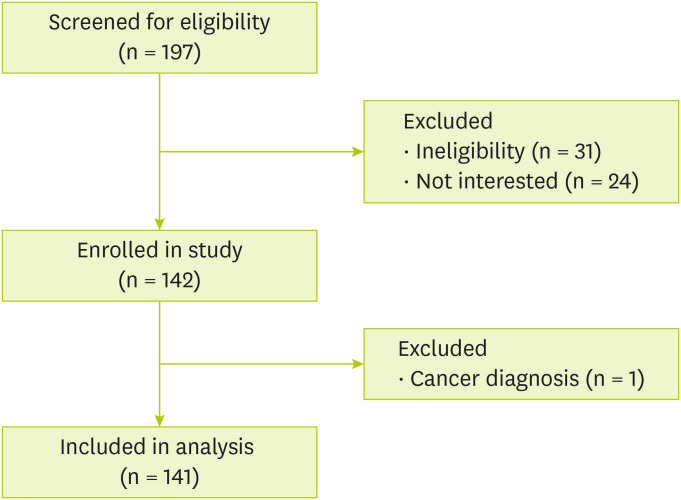
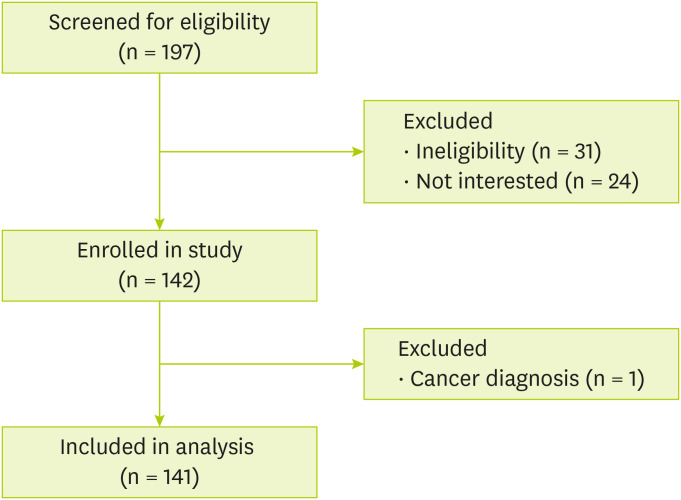
In the current study, 75 men and 66 women participated (
Figure 1). The mean age of in-patients and outpatients was 50.17 ± 15.45 and 43.91 ± 15.77 years respectively. Outpatients were significantly younger than inpatients (p = 0.024). There was no statistically significant difference in BMI between the 2 groups, although the BMI of hospitalized patients was slightly higher (27.66 ± 4.57 vs. 26.53 ± 3.26 kg/m
2).
Figure 1 Flowchart of participant recruitment.
The basic characteristics of participants including dietary intake and biochemical parameters are shown in
Table 1. Inpatients had lower energy intake, around 400 kcal per day, compared to outpatients. In terms of biochemical parameters, no significant differences were observed between the 2 groups. As can be seen, outpatients consumed significantly more servings of vegetables and dairy compared to inpatients, while no significant difference was observed in other food groups. Interestingly, high-fat dairy intake was significantly higher in hospitalized patients than in outpatients.
Table 2 presents the basic characteristics of participants across the dairy intake tertiles.
Table 1 Basic characteristics of study participants based on coronavirus disease 2019 severity
Table 1
|
Characteristics |
In-patients (n = 53) |
Out-patients (n = 88) |
p value |
|
Age (yr) |
50.17 ± 15.45 |
43.91 ± 15.77 |
0.024 |
|
Female |
24 (45.3) |
42 (48.3) |
0.862 |
|
BMI (kg/m2) |
27.66 ± 4.57 |
26.53 ± 3.26 |
0.089 |
|
Dietary intakes |
|
|
|
|
Energy (kcal/d) |
1,542.83 ± 592.03 |
1,920.83 ± 648.07 |
0.001 |
|
Carbohydrate (%) |
59.84 ± 8.98 |
60.44 ± 9.52 |
0.712 |
|
Protein (%) |
13.68 ± 2.48 |
13.43 ± 2.43 |
0.563 |
|
Fat (%) |
29.50 ± 8.00 |
29.68 ± 7.85 |
0.899 |
|
Cholesterol (mg) |
210.48 ± 93.35 |
231.62 ± 110.66 |
0.247 |
|
Fiber (g per 1,000 kcal) |
12.52 ± 3.82 |
13.41 ± 4.41 |
0.229 |
|
Simple sugar (g) |
13.44 ± 7.52 |
15.52 ± 7.55 |
0.115 |
|
Biochemical parameters |
|
|
|
|
WBC (103/µL) |
6.34 ± 1.97 |
6.14 ± 2.24 |
0.638 |
|
NLR |
2.43 ± 2.06 |
1.95 ± 1.14 |
0.157 |
|
IL-6 (pg/mL) |
7.59 ± 15.22 |
11.38 ± 30.99 |
0.582 |
|
CRP (mg/L) |
6.26 ± 7.53 |
4.96 ± 6.22 |
0.294 |
|
Food groups (serving/day) |
|
|
|
|
Fruits |
4.05 ± 2.46 |
4.66 ± 2.42 |
0.166 |
|
Vegetables |
2.49 ± 1.85 |
3.64 ± 2.66 |
0.007 |
|
Grains |
4.38 ± 2.58 |
4.57 ± 2.92 |
0.705 |
|
Meats |
2.78 ± 1.33 |
3.04 ± 1.81 |
0.363 |
|
Dairy |
1.05 ± 0.62 |
1.54 ± 0.95 |
0.001 |
|
|
Low fat |
0.91 ± 0.61 |
1.11 ± 0.83 |
0.143 |
|
|
High fat |
0.14 ± 0.38 |
0.45 ± 0.81 |
0.002 |
Table 2 Basic characteristics of study participants based on dairy intake tertile
Table 2
|
Characteristics |
Tertiles |
p trend |
|
T1 (n = 46) |
T2 (n = 47) |
T3 (n = 48) |
|
Age (yr) |
47.89 ± 15.09 |
44.04 ± 14.21 |
46.75 ± 18.08 |
0.494 |
|
Female |
23 (50.0) |
21 (54.3) |
22 (54.2) |
0.894 |
|
BMI (kg/m2) |
27.29 ± 3.91 |
27.48 ± 3.94 |
26.11 ± 3.57 |
0.168 |
|
Dietary intakes |
|
|
|
|
|
Energy (kcal/d) |
1,450.4 ± 472.2 |
1,795.87 ± 475.3 |
2,076.63 ± 796.6 |
< 0.001 |
|
Carbohydrate (%) |
63.53 ± 10.12 |
60.13 ± 7.61 |
57.13 ± 9.07 |
0.003 |
|
Protein (%) |
12.73 ± 2.57 |
13.20 ± 2.00 |
14.59 ± 2.39 |
< 0.001 |
|
Fat (%) |
27.26 ± 8.66 |
29.91 ± 7.10 |
31.58 ± 7.34 |
0.027 |
|
Cholesterol (mg) |
180.87 ± 93.90 |
211.37 ± 83.40 |
276.74 ± 112.00 |
< 0.001 |
|
Fiber (g per 1,000 kcal) |
14.46 ± 4.29 |
12.49 ± 3.19 |
12.32 ± 4.73 |
0.023 |
|
Simple sugar (g) |
14.36 ± 1.23 |
14.65 ± 7.29 |
15.19 ± 7.23 |
0.865 |
|
Food groups |
|
|
|
|
|
Fruits |
4.38 ± 2.27 |
4.52 ± 2.43 |
4.33 ± 2.69 |
0.936 |
|
Vegetables |
2.65 ± 1.61 |
3.08 ± 1.96 |
3.86 ± 3.28 |
0.050 |
|
Grains |
4.51 ± 2.80 |
4.54 ± 2.22 |
4.44 ± 3.30 |
0.985 |
|
Meats |
2.71 ± 2.15 |
2.72 ± 0.94 |
3.38 ± 1.59 |
0.077 |
|
Dairy |
0.51 ± 0.29 |
1.29 ± 0.27 |
2.24 ± 0.80 |
< 0.001 |
|
|
Low fat |
0.43 ± 0.31 |
0.96 ± 0.54 |
1.68 ± 0.74 |
< 0.001 |
|
|
High fat |
0.08 ± 0.19 |
0.33 ± 0.51 |
0.59 ± 1.02 |
0.002 |
As shown in
Table 3, higher milk intake was associated with a reduced risk of hospitalization due to COVID-19, accordingly patients in the second and third tertiles of milk intake were about 71% and 65% less likely to be hospitalized than those in the first tertile, respectively (p for trend = 0.014). The second tertile of low-fat milk intake was associated with an 11% increase and the third tertile of low-fat milk intake was associated with a 49% decrease in hospitalization risk, which was not statistically significant. Higher intake of yogurt (p for trend = 0.050) and low-fat yogurt (p for trend = 0.039) also showed a significant relationship with reducing the risk of hospitalization due to COVID-19. The second tertile of ice cream intake showed no association with COVID-19 severity, while the third tertile of ice cream intake, although associated with a 27% reduction in hospitalization risk, was not statistically significant.
Table 3 95% odds and confidence interval of the relationship between different dairy intake with the risk of hospitalization
Table 3
|
Characteristics |
Tertiles |
p trend |
|
T1 |
T2 |
T3 |
|
Milk |
1.00 (ref.) |
0.29 (0.11–0.72) |
0.35 (0.13–0.95) |
0.014 |
|
Low fat milk |
1.00 (ref.) |
1.11 (0.51–2.39) |
0.51 (0.19–1.33) |
0.141 |
|
Yoghurt |
1.00 (ref.) |
0.53 (0.19–1.27) |
0.88 (0.22–1.58) |
0.050 |
|
Low fat yoghurt |
1.00 (ref.) |
0.57 (0.16–1.14) |
0.32 (0.11–0.94) |
0.039 |
|
Ice cream |
1.00 (ref.) |
1.00 (0.99–1.01) |
0.73 (0.27–1.47) |
0.152 |
Table 4 shows the association of dairy intake with the risk of COVID-19-associated hospitalization. Firstly, in a crude model it was indicated that higher dairy intake was associated with a reduced risk of hospitalization, although this relationship was not statistically significant. In the second model, after adjustments for age and sex, it is found that in comparison with the first tertile, the risk of hospitalization in the third tertile of dairy intake was 11% (OR, 0.89; 95% CI, 0.71–1.67) and in the second tertile of dairy intake was 15% (OR, 0.85; 95% CI, 0.69–1.45) lower.
Table 4 Odds ratio (95% confidence interval) coronavirus disease 2019-associated hospitalization risk according to tertiles of dairy intake
Table 4
|
Characteristics |
Tertiles of scores |
p trend |
|
T1 |
T2 |
T3 |
|
Mean ± standard deviation |
110.59 ± 60.75 |
275.96 ± 47.54 |
493.42 ± 88.73 |
|
|
Model 1 |
1.00 (ref.) |
0.92 (0.7–1.82) |
0.83 (0.34–1.59) |
0.102 |
|
Model 2 |
1.00 (ref.) |
0.85 (0.69–1.45) |
0.89 (0.71–1.67) |
0.016 |
|
Model 3 |
1.00 (ref.) |
0.74 (0.49–1.05) |
0.69 (0.37–1.25) |
0.023 |
In the last model, all confounding factors including age, sex, BMI, and energy intake were adjusted, which showed that the risk of hospitalization in the highest tertile of dairy intake was 31% lower than in the lowest tertile.
DISCUSSION
The present study assessed the relationship between the consumption of dairy products and the severity of COVID-19. Dietary intake analyses showed that the inpatient group consumed lower amounts of dairy products compared to the outpatient group. On the other hand, higher intakes of dairy products including milk, yogurt, and low-fat yogurt showed a significant relationship with lower severity of the disease. Based on our knowledge this is the first study to report the relationship between dairy products and the severity of COVID-19.
So far, the relationship between dairy consumption and the risk of the severity of COVID-19 has not been investigated, and only limited studies have been conducted on the relationship between dairy consumption and the risk of contracting COVID-19 [
16,
17,
18]. The association between food groups (including dairy products) and the risk of COVID-19 has been investigated in a few studies [
17,
19]. In agreement with the findings of the present study, Cobre et al. [
17] stated that animal protein, including milk, could have protective effects against COVID-19, based on their study of the effects of foods and nutrients on COVID-19 recovery. Contradictorily, a study of the relationship between dietary factors and mortality and infection rates of COVID-19 in 158 countries found that higher milk intake was associated with increased infection rates [
19].
Nutrition plays an important role in human health status. It has been shown that the body needs adequate macronutrients and micronutrients for optimal function [
20]. Following a healthy and balanced diet is one of the crucial strategies for stimulating the immune system against viral infections and reducing the burden of infectious diseases [
21]. It has been demonstrated that consuming foods rich in antioxidants is beneficial for our immune system, for instance, fresh fruits, vegetables, nuts, omega-3 fatty acids, and foods with low saturated and trans fatty acids content [
22,
23,
24]. Vitamins A, B
6, B
12, folate, C, D, and E play an important role in promoting immunity and reducing the risk of infection. Moreover, other nutrients such as zinc, copper, selenium, and iron, as well as amino acids and fatty acids support the immune system. Vitamin A stimulates the expression of immunogenic genes through retinoic acid receptors [
25]. It has been shown that vitamin B
12 has an important role in antiviral defense by supporting the natural killer cells and CD8+ cytotoxic T lymphocyte activity, additionally, the deficiency of vitamin B
12 can reduce the capacity of the phagocytic and bacterial killing of the neutrophils and decrease the number of CD8+ T lymphocytes and the activity of the natural killer cells [
26]. Zinc, in addition to being a cofactor for many enzymes, plays an important role in the function of immune cells [
27].
The role of gut microbiota in immunity has also been proven [
28]. Several studies demonstrated that probiotics have beneficial impacts on reducing the severity of the disease and also in preventing respiratory infections [
29,
30]. The probiotics in yogurt may play a modulatory role in the immune system against the virus. The findings of the present study showed that consumption of yogurt, especially low-fat yogurt, is associated with a reduced risk of hospitalization due to COVID-19. Consistently, in a recent case-control study conducted by Mohseni et al. [
18] in Iran, after adjusting for physical activity, yogurt consumption was significantly associated with a decrease in the occurrence of COVID-19, which can be mainly attributed to its probiotic properties.
Dairy products contain high biological value proteins, minerals, vitamins, and fatty acids which possess many health benefits. It has been proposed that the dairy content of conjugated linoleic acid (CLA) has gut anti-inflammatory properties, which may improve immune activity [
31]. In addition, casein and whey derived from milk proteins can also have anti-viral, antioxidant, and anti-inflammatory properties in lung cells and regulate immune responses [
32].
In the present study, milk showed the greatest effect in reducing the risk of hospitalization due to COVID-19, which was in line with the study of Darand et al. [
16], in which the relationship between dairy products and the risk of COVID infection was investigated. In this study, it was reported that the consumption of low-fat dairy has a protective effect against COVID-19, while a variety of high-fat dairy products are associated with an increased risk of infection. In contrast, in another study, higher milk consumption was associated with an increased rate of COVID-19 infection [
19]. The presence of some high-biological value proteins such as caseins and whey proteins in milk plays a role in reducing oxidative stress and inflammation [
33]. The association of fatty acid called CLA with the reduction of inflammatory markers has also been shown [
31]. It seems that the anti-inflammatory, antioxidant and immune-boosting effects of dairy products reduce the risk of contracting COVID-19 [
17,
33].
In this study, unlike usual case-control studies, outpatients and inpatients were compared and the relationship between dairy intake and the risk of hospitalization due to COVID-19 was assessed. The main limitation of this study was that we were not able to verify the causal relationship between the consumption of dairy products and the infection, due to the cross-sectional design of the study. Another important limitation was that we could not adjust all potential confounders.
In conclusion, our data provide evidence that dairy intake was associated with a lower risk of hospitalization due to COVID-19 and less severe infection.
NOTES
-
Conflict of Interest: The authors declare that they have no competing interests.
-
Author Contributions:
Conceptualization: Yari Z, Abbas-Hashemi SA.
Formal analysis: Yari Z, Hekmatdoost A.
Investigation: Soltanieh S, Salavatizadeh M, Karimi S.
Methodology: Ardestani SK, Jahromi SR.
Project administration: Yari Z, Abbas-Hashemi SA.
Software: Salehi M.
Validation: Ghazanfari T.
Writing - original draft: Yari Z, Abbas-Hashemi SA.
Writing - review & editing: Yari Z, Hekmatdoost A.
ACKNOWLEDGEMENTS
This study is related to the project No. IR.NIMAD.REC.1399.041 from national institute for medical research development entitled “Immunological aspects of COVID-19 in selected provinces of Iran.”
REFERENCES
- 1. Ksiazek TG, Erdman D, Goldsmith CS, Zaki SR, Peret T, Emery S, Tong S, Urbani C, Comer JA, Lim W, Rollin PE, Dowell SF, Ling AE, Humphrey CD, Shieh WJ, Guarner J, Paddock CD, Rota P, Fields B, DeRisi J, Yang JY, Cox N, Hughes JM, LeDuc JW, Bellini WJ, Anderson LJ. SARS Working Group. A novel coronavirus associated with severe acute respiratory syndrome. N Engl J Med 2003;348:1953-1966.
- 2. Alimohamadi Y, Sepandi M, Taghdir M, Hosamirudsari H. Determine the most common clinical symptoms in COVID-19 patients: a systematic review and meta-analysis. J Prev Med Hyg 2020;61:E304-E312.
- 3. Emami A, Javanmardi F, Pirbonyeh N, Akbari A. Prevalence of underlying diseases in hospitalized patients with COVID-19: a systematic review and meta-analysis. Arch Acad Emerg Med 2020;8:e35.
- 4. Yang J, Zheng Y, Gou X, Pu K, Chen Z, Guo Q, Ji R, Wang H, Wang Y, Zhou Y. Prevalence of comorbidities and its effects in patients infected with SARS-CoV-2: a systematic review and meta-analysis. Int J Infect Dis 2020;94:91-95.
- 5. Simonnet A, Chetboun M, Poissy J, Raverdy V, Noulette J, Duhamel A, Labreuche J, Mathieu D, Pattou F, Jourdain M. LICORN and the Lille COVID-19 and Obesity study group. High prevalence of obesity in severe acute respiratory syndrome coronavirus-2 (SARS-CoV-2) requiring invasive mechanical ventilation. Obesity (Silver Spring) 2020;28:1195-1199.
- 6. Calder PC. Nutrition and immunity: lessons for COVID-19. Nutr Diabetes 2021;11:19.
- 7. Morais AH, Aquino JS, da Silva-Maia JK, Vale SH, Maciel BL, Passos TS. Nutritional status, diet and viral respiratory infections: perspectives for severe acute respiratory syndrome coronavirus 2. Br J Nutr 2021;125:851-862.
- 8. Chaari A, Bendriss G, Zakaria D, McVeigh C. Importance of dietary changes during the coronavirus pandemic: how to upgrade your immune response. Front Public Health 2020;8:476.
- 9. Maggini S, Pierre A, Calder PC. Immune function and micronutrient requirements change over the life course. Nutrients 2018;10:1531.
- 10. Gombart AF, Pierre A, Maggini S. A review of micronutrients and the immune system–working in harmony to reduce the risk of infection. Nutrients 2020;12:236.
- 11. Fonseca SC, Rivas I, Romaguera D, Quijal M, Czarlewski W, Vidal A, Fonseca JA, Ballester J, Anto JM, Basagana X, Cunha LM, Bousquet J. Association between consumption of fermented vegetables and COVID-19 mortality at a country level in Europe. medRxiv Forthcoming. 2020.
- 12. Gouda AS, Adbelruhman FG, Sabbah Alenezi H, Mégarbane B. Theoretical benefits of yogurt-derived bioactive peptides and probiotics in COVID-19 patients - a narrative review and hypotheses. Saudi J Biol Sci 2021;28:5897-5905.
- 13. Brown-Riggs C. Nutrition and health disparities: the role of dairy in improving minority health outcomes. Int J Environ Res Public Health 2015;13:ijerph13010028.
- 14. Ghazanfari T, Salehi MR, Namaki S, Arabkheradmand J, Rostamian A, Rajabnia Chenary M, Ghaffarpour S, Kaboudanian Ardestani S, Edalatifard M, Naghizadeh MM, Mohammadi S, Mahloujirad M, Izadi A, Ghanaati H, Beigmohammadi MT, Vodjgani M, Mohammad Shirazi B, Mirsharif ES, Abdollahi A, Mohammadi M, Emadi Kouchak H, Dehghan Manshadi SA, Zamani MS, Mahmoodi Aliabadi M, Jamali D, Khajavirad N, Mohseni Majd AM, Nasiri Z, Faghihzadeh S. Interpretation of hematological, biochemical, and immunological findings of COVID-19 disease: biomarkers associated with severity and mortality. Iran J Allergy Asthma Immunol 2021;20:46-66.
- 15. Mirmiran P, Esfahani FH, Mehrabi Y, Hedayati M, Azizi F. Reliability and relative validity of an FFQ for nutrients in the Tehran lipid and glucose study. Public Health Nutr 2010;13:654-662.
- 16. Darand M, Hassanizadeh S, Marzban A, Mirzaei M, Hosseinzadeh M. The association between dairy products and the risk of COVID-19. Eur J Clin Nutr 2022;76:1583-1589.
- 17. Cobre AF, Surek M, Vilhena RO, Böger B, Fachi MM, Momade DR, Tonin FS, Sarti FM, Pontarolo R. Influence of foods and nutrients on COVID-19 recovery: a multivariate analysis of data from 170 countries using a generalized linear model. Clin Nutr 2022;41:3077-3084.
- 18. Mohseni H, Amini S, Abiri B, Kalantar M, Kaydani M, Barati B, Pirabbasi E, Bahrami F. Are history of dietary intake and food habits of patients with clinical symptoms of COVID 19 different from healthy controls? A case-control study. Clin Nutr ESPEN 2021;42:280-285.
- 19. Abdulah DM, Hassan AB. Relation of dietary factors with infection and mortality rates of COVID-19 across the world. J Nutr Health Aging 2020;24:1011-1018.
- 20. Childs CE, Calder PC, Miles EA. Diet and immune function. Nutrients 2019;11:1933.
- 21. Calder PC, Carr AC, Gombart AF, Eggersdorfer M. Optimal nutritional status for a well-functioning immune system is an important factor to protect against viral infections. Nutrients 2020;12:1181.
- 22. Seidelmann SB, Claggett B, Cheng S, Henglin M, Shah A, Steffen LM, Folsom AR, Rimm EB, Willett WC, Solomon SD. Dietary carbohydrate intake and mortality: a prospective cohort study and meta-analysis. Lancet Public Health 2018;3:e419-e428.
- 23. Cena H, Chieppa M. Coronavirus disease (COVID-19-SARS-CoV-2) and nutrition: is infection in Italy suggesting a connection? Front Immunol 2020;11:944.
- 24. Yahfoufi N, Alsadi N, Jambi M, Matar C. The immunomodulatory and anti-inflammatory role of polyphenols. Nutrients 2018;10:1618.
- 25. Huang Z, Liu Y, Qi G, Brand D, Zheng SG. Role of vitamin A in the Immune system. J Clin Med 2018;7:258.
- 26. Yoshii K, Hosomi K, Sawane K, Kunisawa J. Metabolism of dietary and microbial vitamin B Family in the regulation of host immunity. Front Nutr 2019;6:48.
- 27. Prasad AS. Zinc in human health: effect of zinc on immune cells. Mol Med 2008;14:353-357.
- 28. Calder PC. Nutrition, immunity and COVID-19. BMJ Nutr Prev Health 2020;3:74-92.
- 29. Vouloumanou EK, Makris GC, Karageorgopoulos DE, Falagas ME. Probiotics for the prevention of respiratory tract infections: a systematic review. Int J Antimicrob Agents 2009;34:197.e1-197.10.
- 30. King S, Glanville J, Sanders ME, Fitzgerald A, Varley D. Effectiveness of probiotics on the duration of illness in healthy children and adults who develop common acute respiratory infectious conditions: a systematic review and meta-analysis. Br J Nutr 2014;112:41-54.
- 31. Reynolds CM, Roche HM. Conjugated linoleic acid and inflammatory cell signalling. Prostaglandins Leukot Essent Fatty Acids 2010;82:199-204.
- 32. Batiha GES, Alqarni M, Awad DA, Algammal AM, Nyamota R, Wahed MII, Shah MA, Amin MN, Adetuyi BO, Hetta HF, Cruz-Martins N, Koirala N, Ghosh A, Echeverría J, Pagnossa JP, Sabatier JM. Dairy-derived and egg white proteins in enhancing immune system against COVID-19. Front Nutr 2021;8:629440.
- 33. Young D, Mine Y. Anti-inflammatory/oxidative stress proteins and peptides. In: Mine Y, Li-Chan E, Jiang B, editors. Bioactive proteins and peptides as functional foods and nutraceuticals. Hoboken: Blackwell Publishing Ltd.; 2010. p. 13-27.


 , Zahra Yari2